Smart glasses
experiences that
win the room.
We design and build hands-free experiences for Snap Spectacles and Meta AI glasses: product reveals, live event activations, spatial demos, and voice-first campaigns. When the audience puts the glasses on, something has to happen. Tell us the brief and we will tell you what it takes.
- 01Within 48 hours you get a reply from the studio with a first read on your brief.
- 02One conversation covers feasibility, the right platform, and an honest scope band.
- 03If wearables is wrong for the brief, we say so and point you to the format that fits.
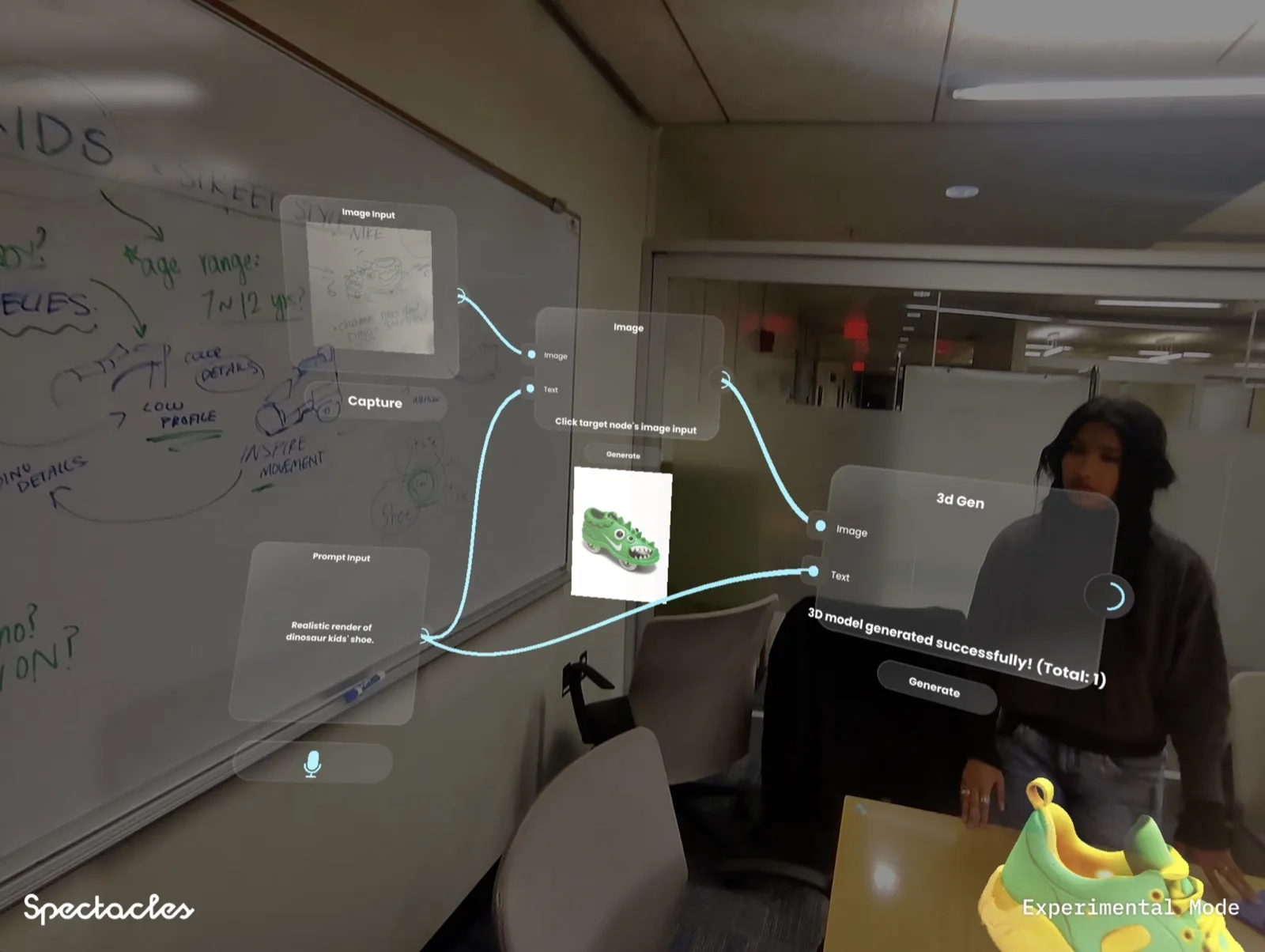
noodle.
A spatial AI workbench built natively for Snap Spectacles. Node-based, hands-free, and device-independent. Trigger a Capture node with your voice. Connect a Prompt node with your hand. Watch a 3D object appear in the space in front of you.
Built in 36 hours at MIT Reality Hack 2026. First place. The same spatial AI approach works for brand builds: connecting a brand asset, a product reveal, a spatially anchored campaign moment to the environment the wearer is standing in.
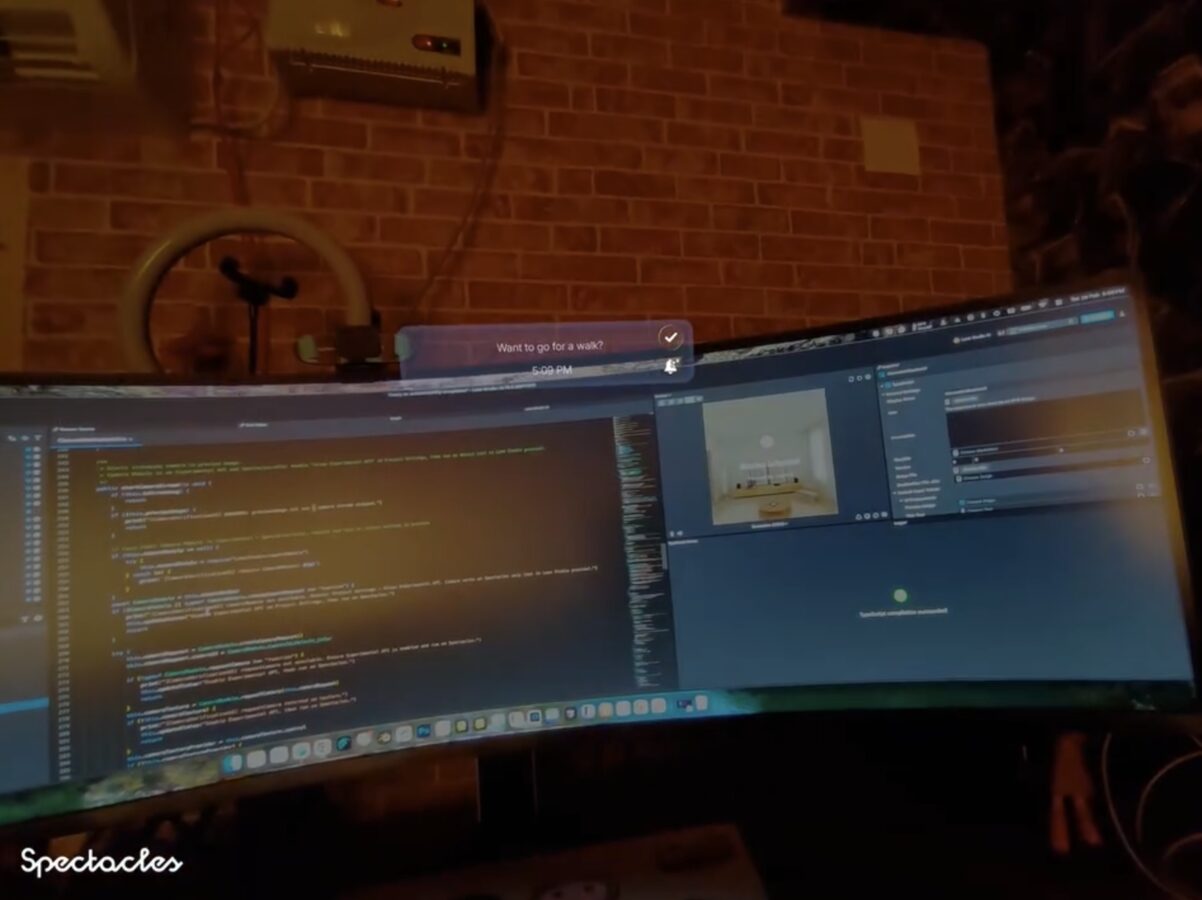
Timely.
An AR habit companion built for Snap Spectacles. Describe a goal in natural language, like "help me stretch every afternoon," and Timely delivers a quiet HUD nudge exactly when it matters. No app to open. No screen to check.
The hard problem was never the AR. It was cutting twenty screens down to five, and designing a notification that respects the wearer's attention instead of fighting for it. Submitted to the Snap Spectacles Lens Contest, 2026.
What we build
on wearables.
Not everything is possible on smart glasses yet. These four formats are.
Live event moments where the physical space becomes the canvas. Product reveals, spatial games, and AR brand moments that live where the audience stands, not on a phone screen held up to the world.
AR try-on, spatial product walkthroughs, and hands-free interaction. Both hands are free, both eyes are on the product. No phone between the audience and the experience. The interaction is the point.
Creator tools, AI generation, and spatial workflows that run entirely hands-free. Voice triggers a node. A hand gesture connects the output. A 3D object appears in the space. Demonstrated at MIT Reality Hack 2026 with noodle.
Creator capture, first-person storytelling, and voice-driven experiences on Meta AI glasses. No display in the lens, so the camera, the voice, and the moment carry the idea. Built for the best-selling smart glasses on the market.
Have a client brief? You keep the relationship.
We bring the spatial thinking, the build, and a scope that is accurate the first time. Credited or behind the scenes, your call. Your client stays yours, and we never approach them directly.
What a wearable
build costs.
No mystery pricing. Scoping is based on interaction complexity, not the hardware. These are the real starting points.
A focused single-interaction experience: a product reveal, a spatial game, a brand moment at an event.
- ✓ One core interaction, voice or hand driven
- ✓ Spatial content anchored to your venue
- ✓ Working prototype on real hardware, early
- ✓ Setup guide so your team can run it on the day
- ✓ Typical timeline: 3 to 5 weeks
Multi-scene experiences with custom hand tracking, spatial anchoring, and AI integration where it earns its place.
- ✓ Multi-scene spatial flow designed for your moment
- ✓ Custom hand and voice interaction
- ✓ Spatial anchoring and AI integration as the brief needs
- ✓ Event-day support and a post-launch review
- ✓ Typical timeline: 5 to 10 weeks
You have a brief but no idea if wearables is right for it. One conversation answers that, free.
- ✓ Honest fit check: we tell you if wearables is wrong for the brief
- ✓ Platform recommendation, Spectacles or otherwise
- ✓ Ballpark cost and a realistic timeline
- ✓ No obligation, no follow-up sequence
Urgent event deadline? Compressed timelines are handled on request. noodle went from zero to a winning build in 36 hours, so we know what a deadline looks like. Mention the date in your brief and we will tell you straight away if it is feasible.
Where we build,
device by device.
Snap Spectacles is our primary platform, and it is not the only one. Here is the honest map: what each device can do, and how we deliver on it.
- ✓ Real-time AR rendered in the lens: overlays exist in physical space
- ✓ Hand and voice interaction: no phone, no controller
- ✓ Spatial content anchored to physical location
- ✓ Fully programmable via Lens Studio SDK
- ✓ Voice-first AI experiences and hands-free assistants
- ✓ First-person creator capture and live streaming
- ✓ The biggest consumer reach in smart glasses today
- – No overlays in the lens: not a spatial AR canvas
- ✓ Glanceable in-lens content: prompts, guides, live information
- ✓ HUD design that respects attention, proven in our Timely build
- ✓ We build the software; you source the hardware or we advise on it
- – Developer access is still opening up: timelines need honesty
The broader landscape: Xreal glasses (Air 2, One) are tethered display glasses useful for productivity and media: they show a floating private screen but do not anchor content to the real world. Brilliant Labs Frame is a monocular AI lens focused on ambient information overlays. Neither is a spatial AR build platform. Spectacles leads our spatial work because it is the only consumer device that currently delivers true world-anchored AR at event scale. For a full device comparison, see the 2026 platform guide.
Is your brief right
for wearables?
Most AR shouldn't be AR. The same is true twice over for wearables. Check before either of us spends time scoping it.
Landed in the second column? It does not mean wearables are wrong for your brand. It means this particular brief might land better as social AR, WebAR, or a phone-first build. Send the brief anyway and we will tell you which, honestly, in one reply.
From brief to launch
in 5 to 10 weeks.
Wearable AR has a different design process to social AR or WebAR. The environment is the interface, hands are the input, and space is the canvas. We shape the brief around that reality from day one.
What you bring: a use case, the moment you want the audience to feel, your event date and venue type, and brand assets if you have them.
Start the conversationWhat we've learned
building for smart glasses.
All articles →
Four devices, four completely different jobs. An honest side-by-side covering AR capability, interaction model, and what each platform is actually suited for.
→Five things smart glasses genuinely do in 2026 and three things they cannot yet. An honest capabilities guide for brands and agencies starting to explore the format.
→Six questions every wearable AR brief needs to answer before the first developer conversation. Covers hands, output, platform, audience context, and success criteria.
→What people ask us
about smart glasses.
Tell us what happens
when the glasses go on.
One brief, one honest reply within 48 hours: whether it is feasible, how long it takes, and what it costs. If wearables is wrong for the brief, we say so and point you to the format that fits.
Prefer email? contact@rbkavin.studio · Not sure where to start? Read The UX problem every smart glasses campaign runs into.