The hype problem
Smart glasses have been "almost ready" for a decade. The hype is real. But so is the progress. In 2026 there are things smart glasses can do better than any other device, and things they cannot do yet. Knowing the difference is what separates a good brief from a wasted budget.
The goal of this article is not to sell you on the technology or dismiss it. It is to give you an honest picture of where things stand: what you can build today, what you should wait on, and what that means if you are a brand, a marketer, or someone trying to figure out whether this belongs in your plans.
Five things smart glasses can genuinely do right now
Show AR overlays that exist in physical space
Snap Spectacles can render 3D objects, text, and animations anchored to the real world. A virtual product floating above a physical shelf. A spatial game that uses your room as the level. A brand moment that appears when you look in a specific direction. This is the capability that has no phone equivalent: both eyes open, both hands free, the digital thing is in the room with you.
Run hands-free spatial games
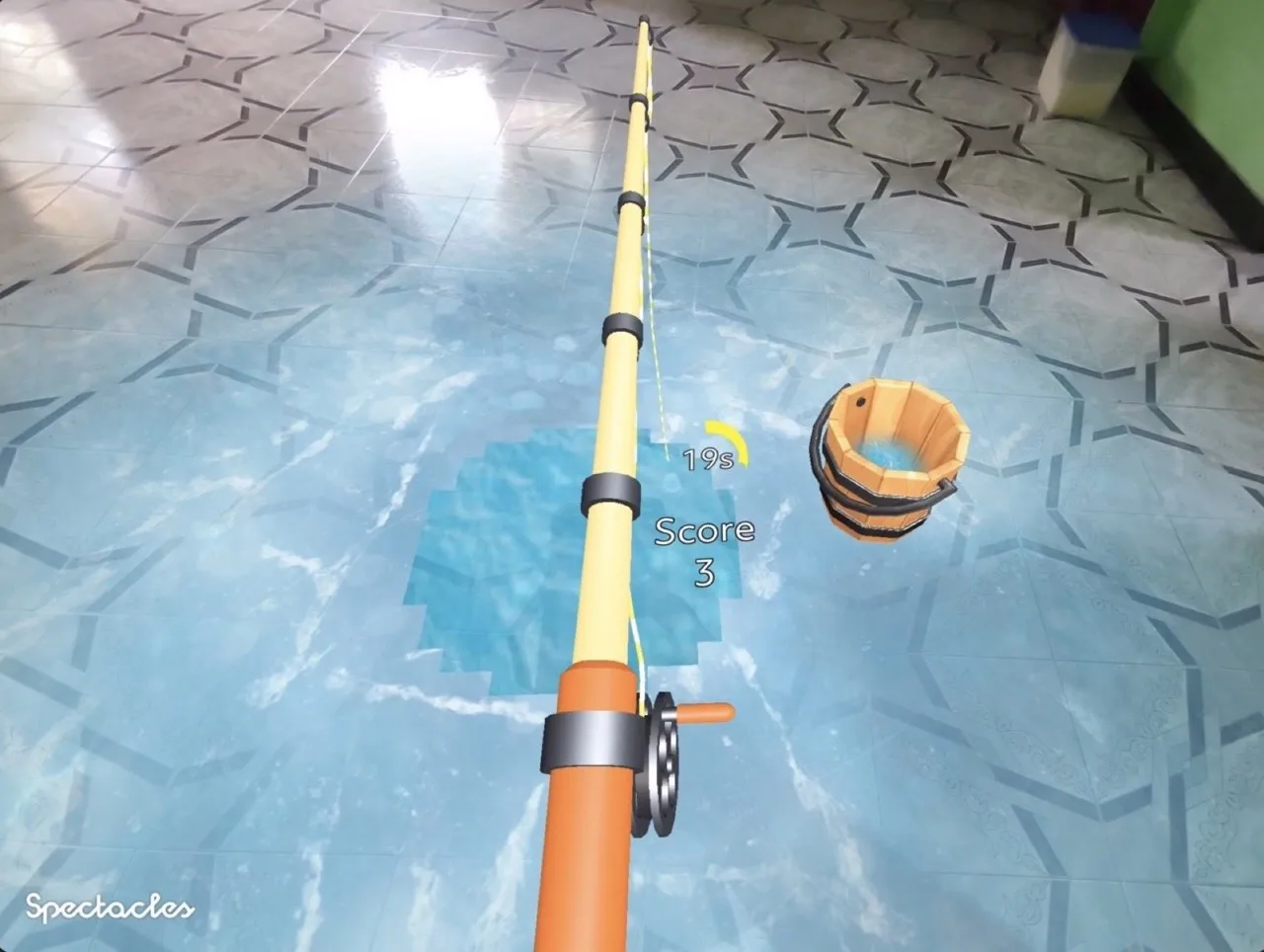
AR games on smart glasses are genuinely fun in a way phone AR is not. Because you are not holding a device, you can move around, use your hands to interact, and stay physically present. The ice-fishing game RBKAVIN. Studio built for Snap Spectacles places a frozen lake in whatever space you are standing in: you cast and reel fish without touching a screen.
Capture first-person video hands-free
Meta Ray-Ban and Snap Spectacles both have cameras. For content creators, the value is immediate: first-person footage from eye level, both hands free, no held camera shaking, natural movement. For brands, this opens a specific type of creator content that looks like real human perspective rather than held-phone footage.
Run voice-activated AI assistants
Both Spectacles and Ray-Ban support voice commands and AI integration. Ask a question, get an answer in your ear or as a floating caption. This is useful for guided demos, navigation, product information, and any experience where the audience needs answers without reaching for a phone.
Run spatial AI creative tools
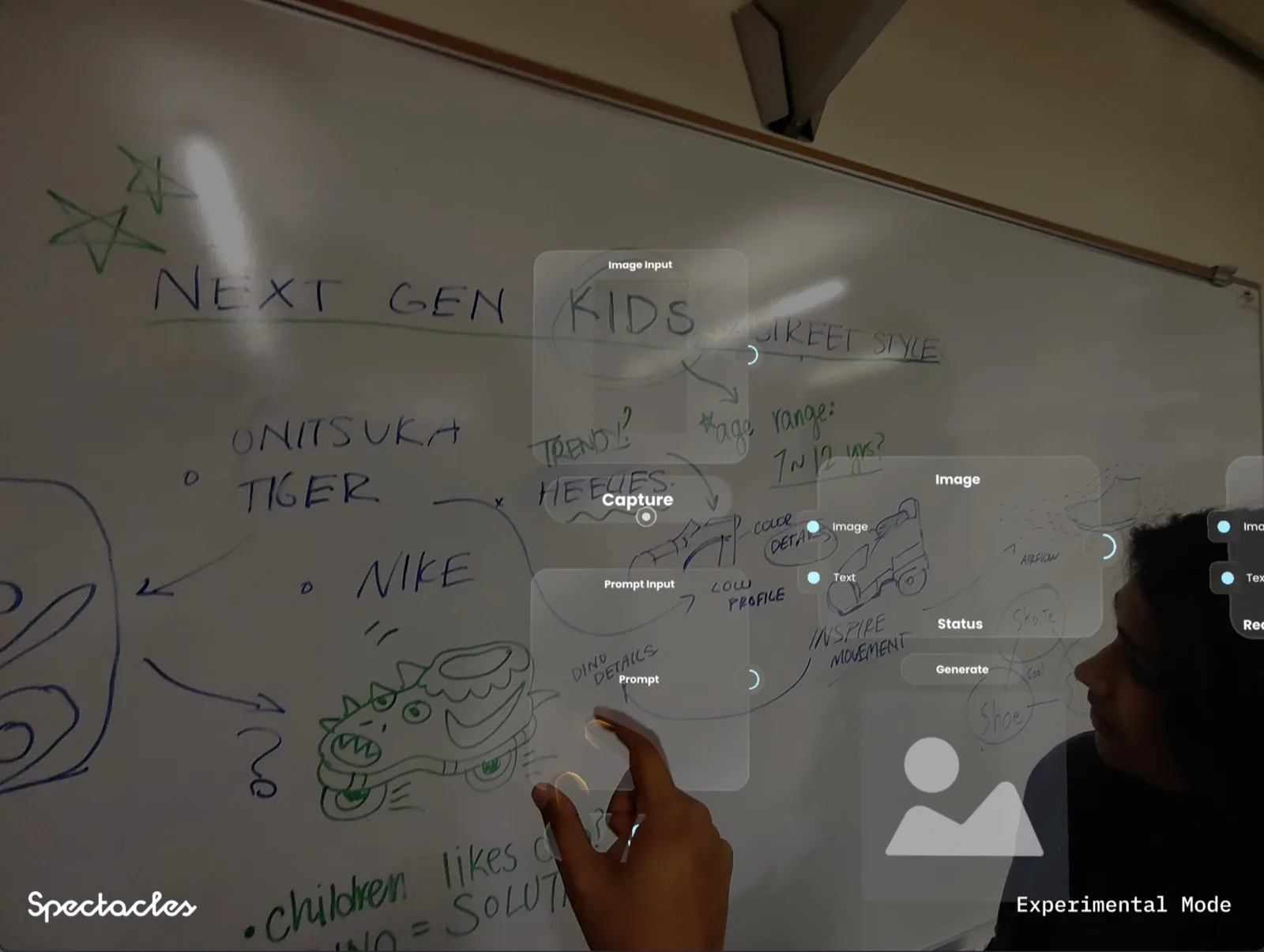
This is the newest capability. The noodle project, built by RBKAVIN. Studio at MIT Reality Hack 2026, is a spatial AI workbench that runs entirely on Snap Spectacles. Connect nodes with your hands, trigger AI generation with your voice, watch 3D outputs appear in the space in front of you. It won first place. It took 36 hours to build. The capability is real.
Three things smart glasses cannot do yet
Full-day battery like regular glasses
Snap Spectacles run for about 30 minutes of active AR use. Ray-Ban lasts longer for audio-only, but heavy camera use drains it fast. Smart glasses are not all-day wearables yet. Design your experience around this constraint, not against it.
A wide-enough field of view
Current AR displays cover roughly 46 degrees of your field of vision. It is not wraparound. It is a floating rectangle at roughly reading distance. Some experiences are designed around this constraint brilliantly. Others fight it and lose. Know the canvas before you design the experience.
A mass consumer audience
Smart glasses are not in millions of pockets yet. Snap Spectacles requires a developer kit. Meta Ray-Ban has better consumer reach but no AR display. For mass-reach campaigns, smart glasses are not the right channel. For event-based activations where you control the audience: they are exactly right.
Which glasses do which things?
The two mainstream platforms serve fundamentally different use cases. Knowing which one your brief calls for shapes everything downstream.
Snap Spectacles 5th gen
46-degree stereo AR display. Hand tracking, voice commands, 6DoF world tracking. Spatial games, brand activations, AI creative tools, anchored 3D content. Requires developer kit. Designed for controlled, event-based use.
Meta Ray-Ban Gen 2
No visual display. Camera, open-ear speakers, voice AI. First-person video capture, AI question-and-answer, spatial audio, creator content. Better consumer reach. The experience is audio-first, not visual.
These are not variations of the same product. A brief that works on Spectacles will not translate directly to Ray-Ban. The design problem, the deliverables, and the audience expectation are all different.
The wider smart glasses market in 2026 includes other devices worth knowing about. Xreal Air 2 and Xreal One are tethered AR glasses that work as a private floating screen connected to a phone or laptop, popular for media consumption and productivity, but they do not anchor content to the real world the way Spectacles does. Brilliant Labs Frame is a small monocular AR lens designed around an AI assistant: useful for real-time info display, but minimal visual field and a narrow use case. Enterprise headsets from Vuzix are workplace tools, not brand experience platforms. The first question in any brief is which device class the experience actually needs, and the answer should come from what you want the audience to feel and do, not from which brand name sounds biggest.
What this means if you are a brand
Right now, smart glasses work best as a layer on top of an existing activation: a product launch event, a press experience, a brand moment you control the environment for. They are not a broadcast channel. They are a depth channel.
The audience that experiences a smart glasses activation remembers it in a way that phone AR does not produce. Both eyes open, both hands free, the thing is in the room with you. That is a different quality of memory. But it requires being deliberate about the moment you are creating.
Brief your experience around one clear moment, not a feature list. What is the single thing the audience should feel? Where in the physical space does it happen? How long does it last? Experiences built around that question consistently outperform experiences built around technology capability.
Frequently asked questions
What can Snap Spectacles do that Meta Ray-Ban cannot?
Snap Spectacles has a true AR display: a 46-degree stereo field of view that renders 3D objects, text, and animations anchored to the real world. Meta Ray-Ban Gen 2 has no display whatsoever. Its output is audio only: voice responses, spatial sound, directional audio cues. The design problem is completely different. Spectacles is a spatial visual experience. Ray-Ban is a conversational audio experience. The two platforms require different creative briefs, different development tools, and different audience expectations.
Are smart glasses useful for brands right now?
Yes, with a clear scope. Smart glasses work best as a layer on top of an existing activation: a product launch event, a press experience, a brand moment you control the environment for. They are not a broadcast channel. The audience that puts them on remembers the experience in a way that phone AR does not produce. The constraint is that they are not mass-market consumer hardware yet, so they suit event-based and controlled activations rather than always-on campaigns.
Do you need a developer to build a smart glasses experience?
Yes. Snap Spectacles experiences are built in Lens Studio using a combination of visual scripting and JavaScript or TypeScript. Meta Ray-Ban experiences use the Meta Spatial SDK. Both require a developer with platform-specific knowledge. Unlike phone AR filters, which can be built with relatively accessible tools, spatial glasses experiences require custom development. The build time for a well-scoped experience is typically four to eight weeks from brief to delivery.
How long does a smart glasses experience need to be designed to run?
Design for ten to fifteen minutes of active use. Snap Spectacles runs for around 30 minutes of active AR, and sustained hand interaction is tiring after about fifteen minutes regardless. A ten to fifteen minute experience is not a short experience: it is a complete one. Forcing that length produces better-paced work with a clear beginning, middle, and end, rather than experiences that pad time with re-engagement loops.
What is the difference between smart glasses and VR headsets?
VR headsets replace your view of the world entirely. Smart glasses overlay digital content on top of the real world, which you can still see clearly. With VR, the user is isolated from their surroundings. With smart glasses, both eyes remain open, both hands are free, and the user can interact naturally with other people in the same room. This changes the social dynamic completely: smart glasses experiences can be witnessed by people not wearing the glasses, which makes them more suitable for brand moments and shared activations.
Insights newsletter
Smart glasses, AR campaigns, spatial computing.
Straight to your inbox. No noise.
SubscribeReady to build something for smart glasses?
We have built spatial games, AI workbenches, and brand activations on Spectacles.
See what is possible on the wearables page, read the briefing guide, or start a conversation.
Start a project