In short: on AI glasses, the agent is the new shelf. Brands that keep clean product data, camera-legible packaging and a presence inside the retailers the agent already talks to will get named in the answer. Brands that only buy media will not.
What Meta and Snap actually announced in September 2026
Two announcements in the same month moved shopping from a demo idea to a platform roadmap. Neither is fully shipping yet, and the difference matters for anything you put in a plan this quarter.
At Connect on 23 September, Meta said it is bringing Muse, its AI agent, to its AI glasses "in the coming months", activated by saying the agent's name. Meta described Muse acting on what the wearer is looking at: "ask about a product on a shelf, a flier on a wall, or a long list of school supplies, and Muse can take action." Meta says Muse launched with dozens of partners and access to the Shopify catalogue, and that it is adding Walmart, Best Buy, American Eagle Outfitters, DICK'S Sporting Goods, Fanatics, Gap, Michael Kors, Sephora, Ulta and Wayfair, plus Shop Pay and PayPal for payments. The same announcement describes shopping AI that identifies products, prices and reviews, and lets people set alerts or buy with their voice.
The developer recap a day later added the build side. The Meta Wearables Device Access Toolkit reached 1.0 after a year in developer preview. Developers can now ship web apps to Meta Ray-Ban Display, and Meta says people will soon be able to discover glasses apps on Ray-Ban Display and in curated sections of the Meta AI app. Meta AI Connectors, which let a service plug into Meta AI through an API or an MCP server, are in developer preview.
On 16 September, Snap announced SPECS Intelligence, an anticipatory AI service across iPhone, Mac and its SPECS AR glasses, and a Shopify partnership that lets wearers browse products in 3D and place them at full scale in the room, powered by the Shopify Catalog. Snap Specs (formerly Spectacles) are available to pre-order at $2,195, and Snap expects shipping to begin later this fall.
| Announcement | Status as of October 2026 | What it means for a brand |
|---|---|---|
| Muse on Meta AI glasses | Announced, "in the coming months" | Visual product questions on glasses. Plan for it, do not promise it in a launch date. |
| New Muse retail partners | Being added, per Meta | If you sell through these retailers, their product feed is how the agent sees you. |
| Device Access Toolkit 1.0 | Launched | Your existing app can use the glasses camera and voice. Buildable now. |
| Web apps on Ray-Ban Display | Available to developers | A lightweight branded tool on the display, built with web skills. |
| Meta AI Connectors | Developer preview | The route for a brand service to be callable by the agent. Early. |
| Shopify 3D shopping on Snap Specs | Announced, no rollout date given | Shopify merchants with 3D assets have a likely path onto Specs. |
How a glasses agent answers "what is this?"
The flow is the same on every platform, even though the details differ. The glasses camera captures what the wearer is looking at. A vision model identifies the object, often from packaging, a logo or a label. The agent then queries whatever sources it is connected to: a retailer catalogue, a commerce platform, reviews. It replies by voice on displayless glasses, or with a short card on a display model like Meta Ray-Ban Display. If the wearer says "buy it", the agent completes the order through a connected retailer or payment partner.
Every step in that chain is a place a brand can win or disappear. If the camera cannot tell your product from the one next to it, the agent describes the wrong thing. If your shade names or model numbers differ between your site and the retailer's feed, the agent may quote the wrong price or say it is out of stock. If you are not stocked by a connected retailer, the purchase step routes to someone else.
This is different from the voice-only experiences covered in our guide to voice AI on smart glasses. There, the brand designs a conversation. Here, the brand mostly does not design the conversation at all. The platform's agent does. What the brand controls is the material the agent works from.
Your product data is now your shelf presence
On a phone, a weak product page still gets a click if the ad is good. On glasses, there is no ad slot between the question and the answer. The agent reads the data and speaks. That makes product data a creative asset, not an e-commerce chore.
For a beauty brand, that means every shade has one name, one hex value and one SKU across your site, Sephora, Ulta and Amazon. For a consumer electronics brand, it means model numbers, compatibility and what is in the box are written the same way everywhere. Ingredients, sizes, variants and current price should be in structured fields, not buried in an image or a PDF. Reviews matter too: Meta describes the shopping AI as surfacing products, prices and reviews together.
The practical test is simple. Ask a current AI assistant about three of your hero products by name, then by description ("the green tube moisturiser with the white cap"). Note where the answer is wrong, vague or names a competitor. That gap is the brief.
Packaging has to be legible to a camera
Visual questions are the core of glasses shopping. Muse is pitched on acting on what you are looking at, so packaging becomes an input, not just a display surface. A pack that is clear to a person at arm's length can still be hard for a model if the front is mostly texture, the product name is small, or every variant in the range looks identical apart from a tiny colour dot.
We have built recognition-triggered AR before. Our portfolio includes image-tracking work where a printed object, such as a five dollar bill or a book, becomes the trigger for an experience. The lesson carries over directly: high-contrast logos, a readable product name and a distinct visual per variant make recognition reliable. Busy, low-contrast fronts do not.
You do not need to redesign packaging for glasses. You do need to test it. Point a phone camera at the shelf from one to two metres, in store lighting, and ask an assistant what it sees. If it cannot tell variant A from variant B, neither will a glasses agent.
Being a connector, or being inside one
Most brands will reach glasses agents through someone else's integration. If you sell through Walmart, Best Buy, Sephora or Ulta, those retailers' connections to Muse are likely to be the path. If you sell direct on Shopify, the Shopify catalogue is the path on both Meta, where Meta says Muse has access to it, and Snap Specs, where the 3D shopping partnership is powered by it.
Becoming a connector yourself is possible but early. Meta AI Connectors are in developer preview, and they suit brands with a real service to offer: a booking system, a loyalty account, a fit or shade advisor. A brand without that service gains little from a connector of its own. Its effort is better spent making sure the retailer feeds are complete and accurate.
For Snap Specs specifically, 3D product models are the asset that matters. Placing a product at full scale in a room only works if a usable 3D model exists. Brands that already commissioned 3D models for AR try-on or AR mirrors in retail are ahead.
What a brand can commission today, and what the platform controls
This is the line most briefs blur. The platform decides how the agent behaves. The brand decides what it gives the agent, and what it builds around it.
| Area | Platform controls | Brand can commission |
|---|---|---|
| Answers | Which products the agent names and in what order | Product data audit across your site and retailer feeds |
| Recognition | The vision model and what it is trained on | Camera legibility test of packaging and point of sale |
| Checkout | Which retailers and payment partners are connected | Distribution decisions, Shopify catalogue readiness |
| Apps | Discovery surfaces and approval | A glasses extension of your app via the Device Access Toolkit, or a web app on Ray-Ban Display |
| 3D | How Specs presents products in the room | Production-quality 3D product models, a Specs Lens |
| In store | Nothing | Staffed glasses demos, AR mirrors, try-on, packaging-triggered AR |
The capability tiers behind each of those builds, what runs on-device and what needs a server, are covered in our guide to AI and smart glasses for brands. For Meta's displayless and display hardware specifically, see Meta Ray-Ban for brand campaigns, and for the toolkit itself, our Meta Wearables Device Access Toolkit guide.
In-store moments are where brands still own the experience
The agent flow is controlled by the platform. A store is not. A staffed demo, a counter with glasses ready to try, or an AR mirror is a moment the brand designs end to end, and it is where most shoppers will first try glasses shopping at all.
Our retail-adjacent work points the same way. For easyJet we built a 3D uniform try-on for Instagram and Snapchat, where on Snapchat body tracking fits the outfit to the user's real silhouette. For Pandora, via Simone Agency, we built an Instagram AR experience where people catch charm pieces to build a personalised bracelet. Both are phone AR. Both rely on the same thing glasses shopping will rely on: accurate 3D product assets and a mechanic people understand in seconds. The live WebAR demos at ar.rbkavin.studio show the phone side of this today.
A practical 2026 pilot sits between the two: a branded experience on glasses inside your own store or event, where you control the hardware, the lighting, the products on the shelf and the staff. You learn what shoppers ask before the open-world agent asks it for them.
What Noodle taught us about agents that see and act
Noodle, the spatial AI workbench our team built on Snap Spectacles at MIT Reality Hack 2026, used the same pattern a shopping agent uses: the camera reads something physical, a voice prompt sets intent, and an AI pipeline returns a result into the wearer's space. It won three prizes there: the Founders Lab Track Prize, Best Use of Spatial AI, and the Snap Spectacles Community Challenge.
The lesson that transfers to retail is latency. Generative AI in Noodle took 10 to 30 seconds to return an output, so the interface had to show progress in the space rather than leave the wearer staring at nothing. Shopping agents will have their own waits: recognition, a catalogue lookup, a payment check. A brand experience on glasses has to design for those seconds, not assume an instant answer. The Noodle case study covers how we handled it, and our wearables work shows where it fits in the wider practice.
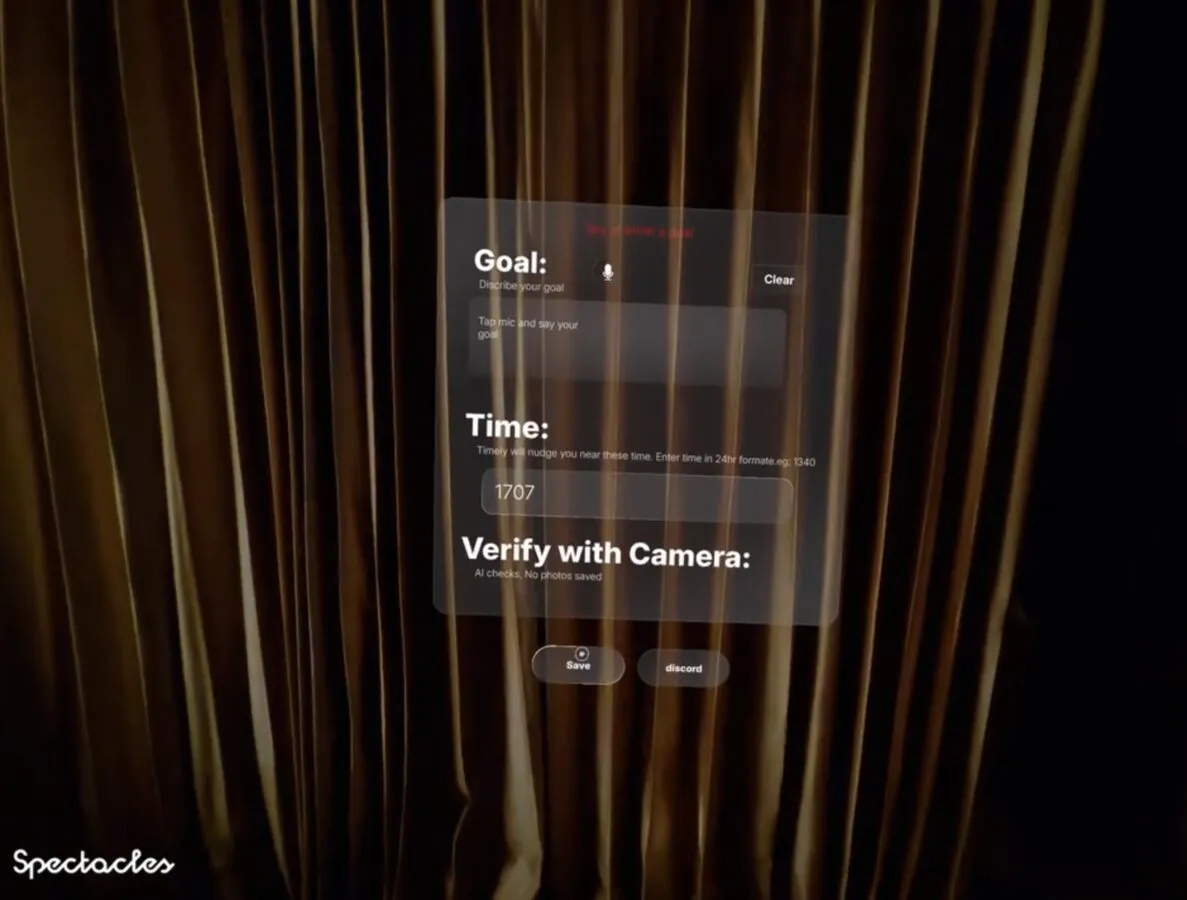
We also designed Timely, an AR habit companion for Snap Spectacles, around the same principle: setup by voice, and a nudge that resolves in a single gesture. On glasses, every extra step is a step the wearer skips.
A brief checklist for AI glasses shopping in 2026
- List your top 20 products and check name, variants, price and stock are identical on your site and every retailer feed.
- Run a camera legibility test on packaging in real store lighting, and fix variants that look identical.
- Confirm which of your retailers are named Muse partners, and whether your Shopify catalogue is complete.
- Audit your 3D product models. If none exist, commission them for your hero range first.
- Decide whether you have a service worth a connector, or whether retailer feeds are enough.
- Scope one owned in-store or event pilot on glasses before relying on the open-world agent.
- Write "announced" or "shipping" next to every platform feature in the plan, and date-check it before launch.
Frequently asked questions
Can I shop with AI glasses today?
Partly. Meta announced in September 2026 that its Muse agent is coming to its AI glasses in the coming months, with visual product questions and voice purchases through partners such as Walmart, Best Buy, Sephora, Ulta and Gap being added. Snap announced Shopify-powered 3D shopping for Snap Specs, available to pre-order at $2,195 with shipping expected later this fall. Treat both as near-term rather than live at scale.
How do I get my products recommended by a smart glasses AI agent?
You cannot buy a place in the answer the way you buy a search ad. The levers are accurate structured product data on your site and retailer feeds, packaging a camera can recognise, good reviews, and distribution through retailers or platforms the agent is connected to, such as the Shopify catalogue. Start with a data audit of your hero products.
Do brands need their own app for AI glasses shopping?
Usually not. Most brands will reach glasses agents through retailer integrations. An app makes sense if you already have a service worth extending, like a shade finder or loyalty account. Meta's Wearables Device Access Toolkit 1.0 lets an existing mobile app use the glasses camera and voice, and web apps can run on Meta Ray-Ban Display.
What is the difference between Meta Muse and Snap SPECS Intelligence for retail?
Muse is an agent that answers questions about what you are looking at and can complete purchases through connected retailers and payment partners. SPECS Intelligence is an anticipatory AI service that surfaces information based on your goals and routines, and Snap's Shopify partnership adds 3D products placed at full scale in the room. Muse favours retailer data; Specs favours 3D assets.
What does a smart glasses retail pilot cost?
It depends on scope, but the cheapest useful steps are not builds at all. A product data audit and a packaging camera test are small projects. A branded experience on glasses for an owned store or event, with 3D product assets and staffed demos, is a production budget comparable to a premium AR activation. Ask for the asset work and the glasses build to be priced separately.
Will AI glasses replace AR try-on and AR mirrors?
Not soon. Glasses agents answer questions and handle purchase steps, while try-on and AR mirrors show the product on the shopper's body or in a shared public moment. The 3D models built for try-on are the same assets glasses platforms like Snap Specs need, so that work carries over rather than being replaced.
Insights newsletter
Smart glasses, AR campaigns, spatial computing.
Straight to your inbox. No noise.
SubscribeGetting your products ready for AI glasses?
Send us your hero range. We will tell you what a glasses agent sees today, and what to build so it sees you correctly.
Start a project