The gap between "AI glasses" marketing and what ships
Every smart glasses announcement in 2025 and 2026 used the phrase "AI-powered." The phrase is doing a lot of work. Meta Ray-Ban call their voice assistant AI. Brilliant Labs Frame is built around an AI model. Snap Spectacles run AI-driven hand tracking and world understanding. Xreal has an AI mode tied to a connected phone.
These are not the same thing. The AI in Meta Ray-Ban is a voice assistant that happens to live in a pair of glasses. The AI in Spectacles is a spatial model that understands the geometry of a room and places objects in it. Conflating them makes briefs impossible to scope. Before you can evaluate a smart glasses AI brief, you need to know which capability tier you are actually asking for.
The gap is not between "has AI" and "has no AI." The gap is between marketing language and capability specifics. This article names the specifics.
What AI genuinely does on-device today
The following capabilities are available on current smart glasses hardware and do not require a continuous server connection to function. They have shipped in production builds, not just labs.

Voice command and wake-word detection
All major smart glasses platforms handle voice wake-word detection on-device. The glasses listen for a trigger phrase locally, with no internet required. Meta Ray-Ban, Spectacles, and Brilliant Labs Frame all support this. The on-device voice layer is fast, private, and reliable in noisy environments. What the voice command does next may or may not require a server, depending on the task.
Object and scene recognition
Glasses with a front-facing camera can classify what they are looking at using on-device models. Current hardware can reliably identify product categories, text, faces (where permitted), and common objects. The classification is not comprehensive, but it is sufficient for a curated activation scenario: recognise a specific product, logo, or spatial marker, then trigger an overlay. This is production-usable on Spectacles and Brilliant Labs Frame today.
Contextual overlays triggered by what the wearer sees
The output side of vision AI is the part brands most want. The glasses see a product, a location, or a trigger marker, and respond with a spatial overlay relevant to that context. At a brand activation, this can mean: pick up a product, see its specs appear in your field of view; stand in a specific zone, see an exclusive piece of content unlock. This is not a future feature. It is in current platform SDKs. RBKAVIN. Studio builds this type of experience on wearables, and the live demos at ar.rbkavin.studio show the output quality on real devices.
Real-time translation
Brilliant Labs Frame ships real-time spoken language translation as a core feature. On Spectacles, translation can be integrated via a Lens that connects to a translation API and surfaces subtitles as a spatial overlay. The on-device translation models are lightweight but limited to common language pairs. For broader coverage, a server round-trip of 200-400ms is typical. At a conference or brand event with reliable network infrastructure, this is imperceptible. In a congested public Wi-Fi environment, it adds noticeable lag.
Generative prompts from camera input
The camera sees something, the wearer asks a question, and a multimodal AI model processes both together. "What is this?" pointed at a product. "Translate the menu on the wall." "What does this chart show?" This works on Meta Ray-Ban via the Meta AI backend and on Spectacles via a developer-connected multimodal API. The round-trip is server-dependent and takes 1-3 seconds. Good enough for conversational use. Not suitable for instant overlay feedback that needs to feel immediate.
Server vs on-device: why the distinction matters for a live event

For a brand brief that involves 50 people in a showroom, this distinction is minor. For a brief that involves 5,000 people at a stadium launch, it is the difference between a working experience and a failed one.
A live event crowd saturates venue Wi-Fi. Mobile data in a dense crowd is unreliable. Any AI feature that requires a server round-trip will fail intermittently or degrade significantly when your activation goes live and every attendee is on the same network.
Good experience design accounts for this from the brief stage. The rule is: core experience loops must work offline or on-device. Server AI is additive, not foundational. If the AI fails to connect, the experience still runs. The AI layer enhances it when network conditions allow.
This is not a technical footnote. It is the most common failure pattern in smart glasses activations, and it is entirely preventable if the brief addresses it. The smart glasses UX article covers the broader pattern of designing for real constraints rather than demo conditions.
Noodle: what it proves about AI on current hardware
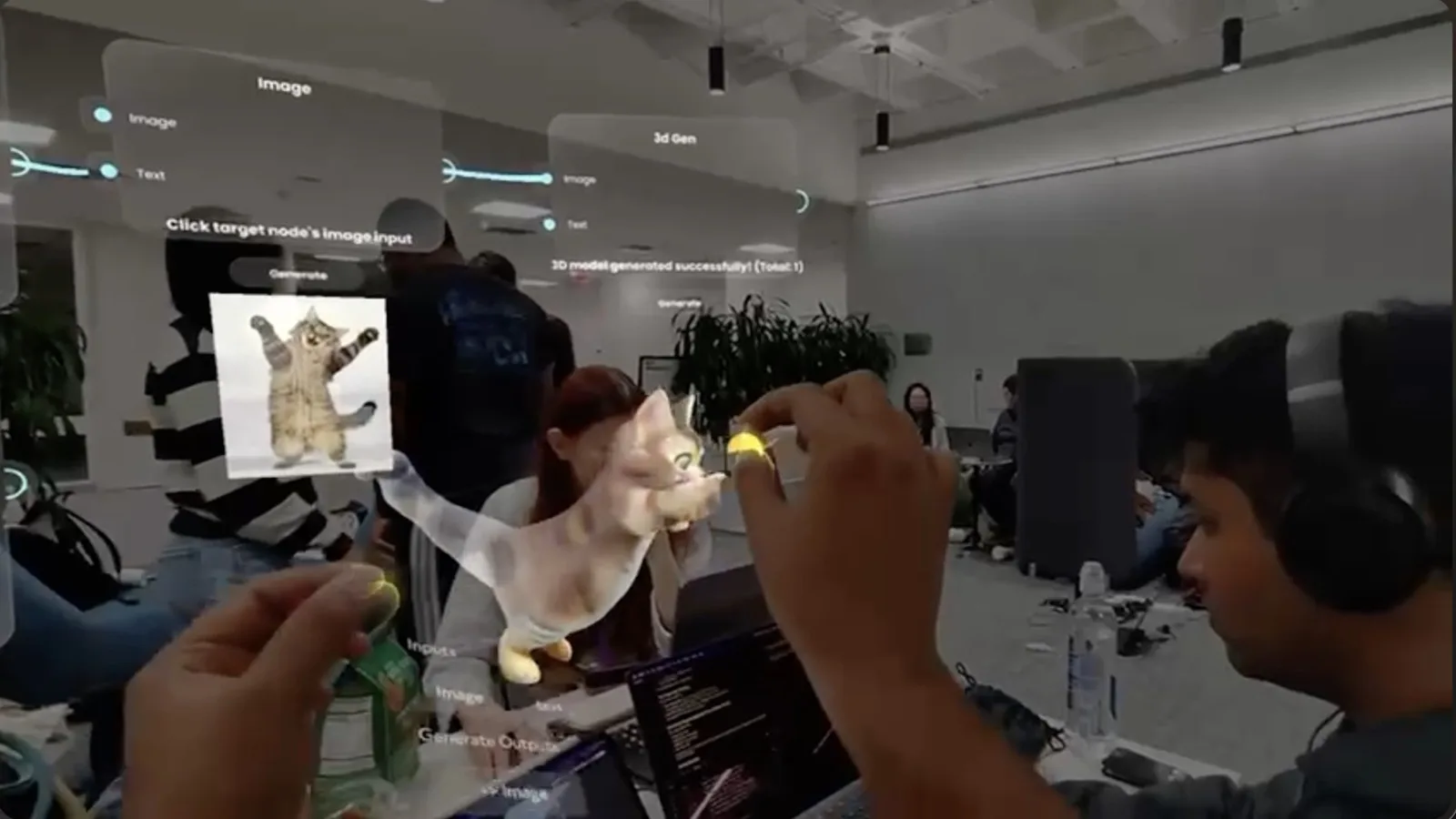
In early 2026, RBKAVIN. Studio built Noodle for MIT Reality Hack 2026. It won. Noodle is a spatial AI workbench that runs on Snap Spectacles. It combines three AI modalities simultaneously: voice input (the wearer speaks commands), live camera vision (the glasses see the environment and the wearer's hands), and spatial reasoning (AI interprets both inputs and updates a node graph that floats in the physical room around the wearer).
The wearer can navigate and manipulate a floating node graph using their hands and voice, with no phone, no controller, and no external tracking system. The session ran in a public venue with other teams, noise, movement, and variable lighting.
What Noodle proves: multimodal AI, combining voice and vision inputs into a single spatial output, is achievable on current Spectacles hardware without a dedicated server. The experience was interactive, low-latency within the on-device processing loop, and stable across multiple demo sessions. The full build story is in the Noodle case study.
For brands evaluating AI smart glasses activations, Noodle is a useful proof point. It sets a concrete benchmark for what is achievable on current hardware in a live environment, not in a controlled lab.
What brands can realistically commission in 2026
These are production-feasible AI smart glasses experiences with current hardware and platform SDKs. They have been built, tested, and deployed, not just specced in a deck.

The platform comparison article covers which devices support which capability tiers, including AI-specific features per platform.
What is still prototype-stage and not ready for mass activation
Being direct about this matters more than it might seem. Every year, briefs arrive that describe capabilities that are genuinely exciting but not deployable at scale in 2026. Building against them creates expensive, publicly visible failures.
Persistent cross-session memory on-device (the glasses remember what you showed them last week) is not mature on any consumer platform. Emotion or sentiment recognition from facial expressions is not reliable enough for production, and it raises significant consent issues in a brand context. Real-time fully generative 3D content, the glasses generate a unique visual environment on the fly for each wearer, requires server compute and current latency sits at 3-8 seconds, which breaks the immediacy needed for crowd activations.
None of these are permanent limitations. The hardware trajectory is clear. But a brief written today that depends on them will fail today.
How to write a brief that separates real AI features from demo-ware
The clearest test for any AI smart glasses feature in a brief: ask for the input and the output.
Input: what does the AI perceive? Voice, camera, location, motion sensor, a specific marker? Output: what does it do? An overlay appears, audio plays, content swaps, the experience branches to a new state? If the brief cannot answer both clearly, it is not a specification, it is a vibe.
The second test: does this work if the network drops? If the answer is "no, the experience stops," the core loop depends on server AI and needs to be redesigned or you need to budget for a dedicated local network at the venue.
The third test: has something similar been built and deployed in a live environment? Not demonstrated in a lab video. Deployed, at scale, in front of a real audience. Proof of production deployment matters more than technical feasibility in theory. Ask the studio you are briefing for real-world examples with known audience sizes and network conditions.
A good brief for an AI smart glasses experience answers: the input modalities, the output behaviour, the network dependency, the fallback state, and the audience size. Anything that checks those five boxes can be scoped and built with confidence.
Frequently asked questions
What can AI actually do on smart glasses right now?
AI on smart glasses can perform real-time translation of spoken language, recognise objects and scenes through the camera, respond to voice commands, trigger contextual overlays based on what the wearer is looking at, and generate responses from live camera input. On platforms like Snap Spectacles, these capabilities are available to developers today via the SnapOS API. What varies is whether the AI runs locally on the device or needs a server connection, and that distinction determines whether the experience works in a crowded venue with unreliable Wi-Fi.
What is the difference between on-device AI and server AI on smart glasses?
On-device AI runs directly on the glasses' processor with no internet required: it is fast, private, and works offline. Voice wake-word detection and basic object classification typically run on-device. Server AI sends data to a cloud model and returns a result: it is more capable but adds latency and requires connectivity. At a live event with 5,000 people all on the same network, server-dependent AI will stall. Good smart glasses experience design accounts for this from the brief stage, not as a fix at QA.
Can smart glasses do real-time translation for a brand event?
Yes, with constraints. Platforms like Brilliant Labs Frame are explicitly built for real-time translation and transcription via on-device or lightweight server AI. Snap Spectacles can surface translated subtitles as a spatial overlay through custom Lens development. The constraint for large events is latency: translation requires a server round-trip unless you have a dedicated local server or offline model. For a 200-person conference with good Wi-Fi, translation works reliably. For a 5,000-person stadium event on shared public Wi-Fi, you need an offline fallback strategy.
What is Noodle and what does it prove about AI on smart glasses?
Noodle is a spatial AI workbench built for Snap Spectacles by RBKAVIN. Studio, which won MIT Reality Hack 2026. It combines voice input, live camera vision, and spatial reasoning to let the wearer manipulate a node graph that exists physically in the room around them. It proves that multimodal AI, processing voice and vision together in real time, can run on current smart glasses hardware in a public event environment with no dedicated server setup required for the core experience loop.
How do I write a brief for a smart glasses AI experience?
Start by specifying the input and the output. Input: what does the AI perceive? Voice, camera, a marker, a location? Output: what does it do? An overlay appears, content swaps, the experience branches? Then ask: does this work if the network drops? And has something similar been deployed at scale in a live environment, not just shown in a lab demo? A brief that answers input, output, network dependency, fallback state, and audience size can be scoped and built reliably.
What smart glasses AI features are still prototype-stage in 2026?
Reliable full-scene semantic understanding is still research-grade. Persistent cross-session memory on-device is not mature on any consumer platform. Real-time fully generative 3D content requires server compute and current latency (3-8 seconds) is too high for crowd activations. Emotion or sentiment recognition from facial expressions is not reliable enough for production and raises consent issues in a brand context. These capabilities exist in labs. Building a mass brand activation around them in 2026 is premature.
Insights newsletter
Smart glasses, AR campaigns, spatial computing.
Straight to your inbox. No noise.
SubscribeCommission a smart glasses AI experience
RBKAVIN. Studio builds on Snap Spectacles, Meta Ray-Ban, and Xreal. We scope AI features against real hardware constraints, not deck promises. Tell us what you want to build.