New to this? See the 60-second visual explainer first, flip a switch and watch the same pair of glasses go from plain to AR.
They are not what most people picture
Ask someone to picture smart glasses and they usually imagine something bulky: a VR headset, a visor, something from a film set in 2045. The reality is far more ordinary-looking. Smart glasses look like glasses. Thick ones, sure. Sporty ones in some cases. But glasses you would recognise as glasses if you passed someone wearing them on the street.
The key difference from a phone is deceptively simple: you wear them. Both eyes stay open. Both hands are free. You are not looking down at a screen; you are looking at the world, and the world has gained a layer. That shift sounds small and turns out to change everything about how you interact with digital content.
Want to see what actually appears in them? Try the 60-second visual version, flip a switch and watch a lens draw content into the wearer's view.
They are also not the same as VR headsets. VR replaces what you see entirely. Smart glasses sit on top of reality, adding to it rather than replacing it. That distinction matters for how you use them, what you build for them, and how comfortable the people around you feel when you are wearing them.
Two very different types exist
Not all smart glasses work the same way. The two most relevant devices today do fundamentally different things, and conflating them causes a lot of confusion.
This is worth being clear about: these are not better and worse versions of the same thing. They are different devices that solve different problems. Spectacles are for building and experiencing visual AR. Ray-Ban are for capture, audio, and ambient AI. If someone tells you smart glasses are overhyped because Ray-Ban do not have AR, they are comparing the wrong thing.
The smart glasses market in 2026 is wider than just those two. Xreal (Air 2, One) makes tethered AR glasses that connect to a phone or laptop and act as a floating private screen, useful for productivity and media, though the AR is display-based rather than world-anchored. Brilliant Labs Frame takes a different angle: a small monocular lens with an AI assistant built in, closer to a heads-up display than a spatial AR device. Enterprise AR glasses from companies like Vuzix serve industrial and logistics use cases. Each solves a different problem. None of them compete directly with Spectacles for immersive brand experiences, because the interaction model and display capability are fundamentally different. But they are all part of the same broad category, and the market is still early enough that the category itself is still being defined.
What you actually see through smart glasses
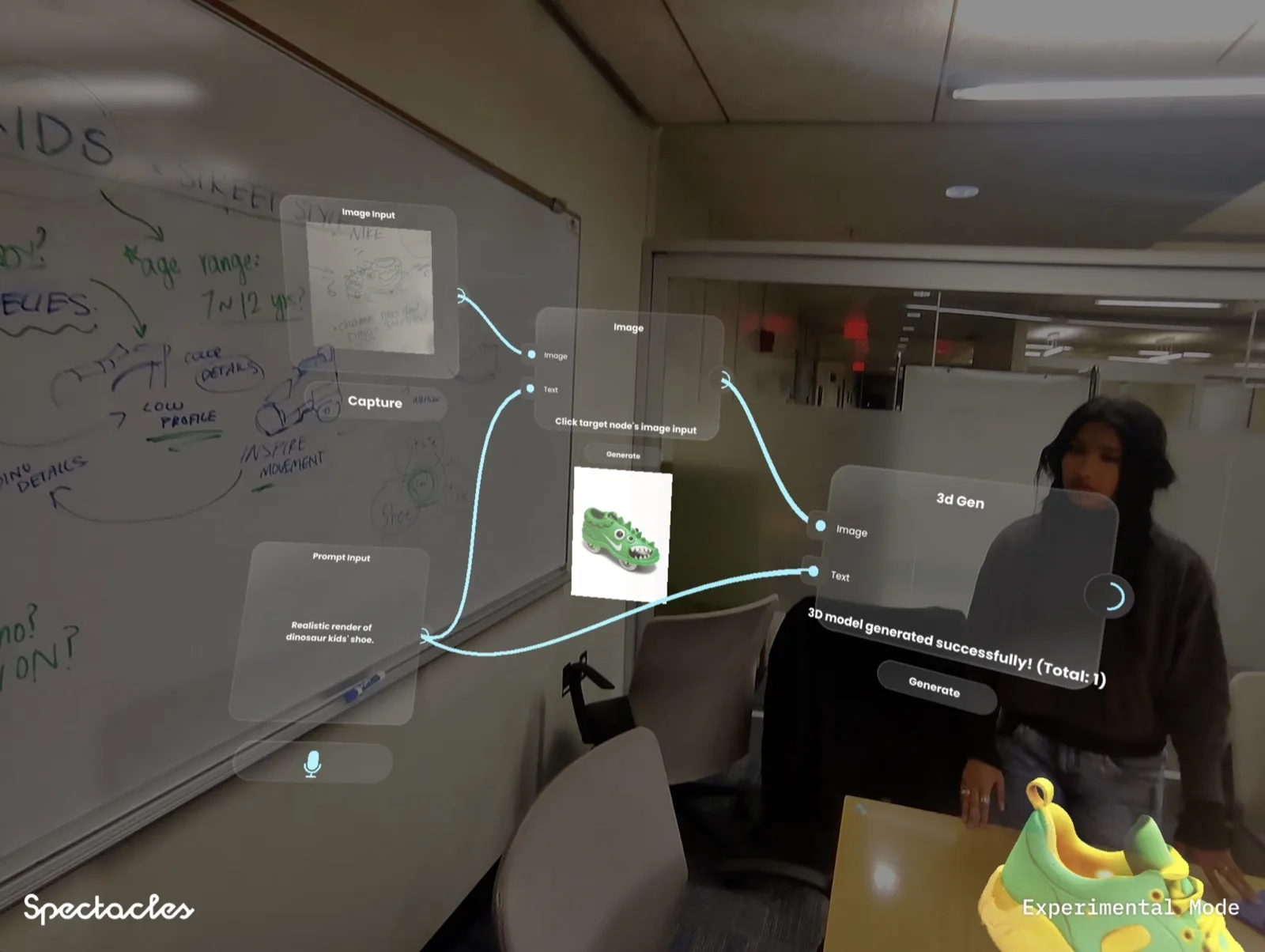
Through Snap Spectacles, you see the real world plus a digital layer. The display renders in a roughly 46-degree field of view in front of your eyes. Within that window, you can see floating 3D objects, spatial text panels, game elements anchored to physical surfaces, and UI that tracks your head movement. A virtual fish tank can sit on a real table. A node graph can float in the middle of a room. A score counter can appear above a physical target. None of it is on a screen. All of it exists, visually, in the space around you.
Through Meta Ray-Ban, you see the world exactly as you normally would. No overlay. No digital layer. The AR equivalent here is audio: you can ask a question and hear the answer without pulling out your phone. The camera lets someone else see your point of view via a live stream. The glasses are aware of their environment in the sense that Meta AI can respond to what you describe, but your eyes do not see anything added.
How smart glasses work
The hardware inside is doing a lot of work to make the experience feel effortless. Four components do most of the heavy lifting.
The camera maps the environment in real time, telling the processor where surfaces are, how far away objects sit, and how the scene is changing as you move. The processor uses that data to place digital content correctly: if you put a virtual object on a table, it needs to stay on that table as you walk around it. The display on AR glasses uses a waveguide, a thin optical element that redirects light from a projector into your eye without blocking your view of the real world. Sensors track your head position and, on more advanced devices, your hands, so you can interact with content by reaching out and touching it.
The result, when it works well, is content that feels like it belongs in the room rather than projected onto it.
Do they look normal?
Honest answer: mostly yes, with caveats.
Meta Ray-Ban look essentially like regular Ray-Ban sunglasses or optical frames. The cameras are small enough that most people would not notice them. People wear these to work, on public transport, and at events without drawing attention. They look unremarkable because they were designed to.
Snap Spectacles look like thick, sporty sunglasses. The lens is noticeably wider than a standard frame to accommodate the waveguide display, and there is visible hardware in the temples. You would recognise them as "something," but they do not look like a VR headset. Most people clock them as sunglasses with a tech angle, not as a device that deserves a double take.
Neither is invisible. The current generation is recognisably wearable tech. The field of view on Spectacles is approximately 46 degrees diagonal, which means you are designing for a window roughly the size of a monitor at arm's length, not a wrap-around display. Full-vision AR that fills your entire field of view is still a generation or two away from consumer hardware. For a device-by-device breakdown of how normal each option actually looks, the wearability guide covers Meta Ray-Ban, Xreal Air 2, Snap Spectacles, and Brilliant Labs Frame side by side.
What smart glasses are used for today
The practical use cases in 2026 are specific and grounded. Smart glasses are not yet a replacement for any existing device. But for the right application, they are the best tool available.
- Spatial AR at brand events and press launches, where an experience placed in a physical space creates a moment that photographs and videos cannot replicate
- Hands-free product demos where both hands need to be free and the presenter needs to stay in the room, not behind a screen
- AR games that place virtual environments in real physical spaces, like a frozen lake appearing in whatever room you are standing in
- First-person content capture for social and documentary use, where a camera at eye level gives footage that a phone cannot
- Spatial AI tools that turn physical space into a workspace: noodle, a spatial AI workbench built for Spectacles, is a practical example of what this looks like in action
- Navigation prototypes and ambient information overlays, still early but showing real promise in controlled contexts

Are smart glasses ready for brands?
Yes, selectively. The honest version of this answer is: not for mass consumer campaigns (not enough people own them), but absolutely for live events, press launches, developer-community moments, and creative activations where the audience is in the room.
The value for brands is not distribution. It is the quality of the experience when someone puts them on. A spatial AR activation at a product launch creates a moment that cannot be replicated on a phone screen. It requires presence. It requires the audience to be there. And it leaves a memory that a banner ad or social post does not.
The brands doing this well right now are treating smart glasses as a premium experiential layer, not as a broadcast channel. That framing changes what you build and how you measure success.
For the full picture on building for wearable AR, and what a smart glasses activation actually involves in practice, the wearables page is where to start.
Frequently asked questions
Want to build something for smart glasses?
Whether it's a brand activation, a spatial experience, or an experiment worth running, the studio builds for Spectacles and the wearable AR ecosystem.