Where it started
This was not a client brief. Nobody asked for it. The prompt was a question we asked ourselves about Snap Spectacles: what kind of experience would be genuinely fun to stumble into, simple enough for someone who has never put on AR glasses before, and relaxed enough that you would want to come back to it?
Fishing came up almost immediately. The activity has a pace and a feel to it that maps well to what smart glasses do well: ambient presence, a sense of place, patient waiting that gives way to a moment of action. The question was how to make the interaction physical in a way that felt intuitive. The phone answered it.
Hold a phone vertically and it is already shaped like a fishing rod handle. Scroll up to let line out, scroll down to reel it in. That motion maps directly to what your wrist does with a real reel. Nobody needs to be told. They pick it up and start fishing.
The interaction
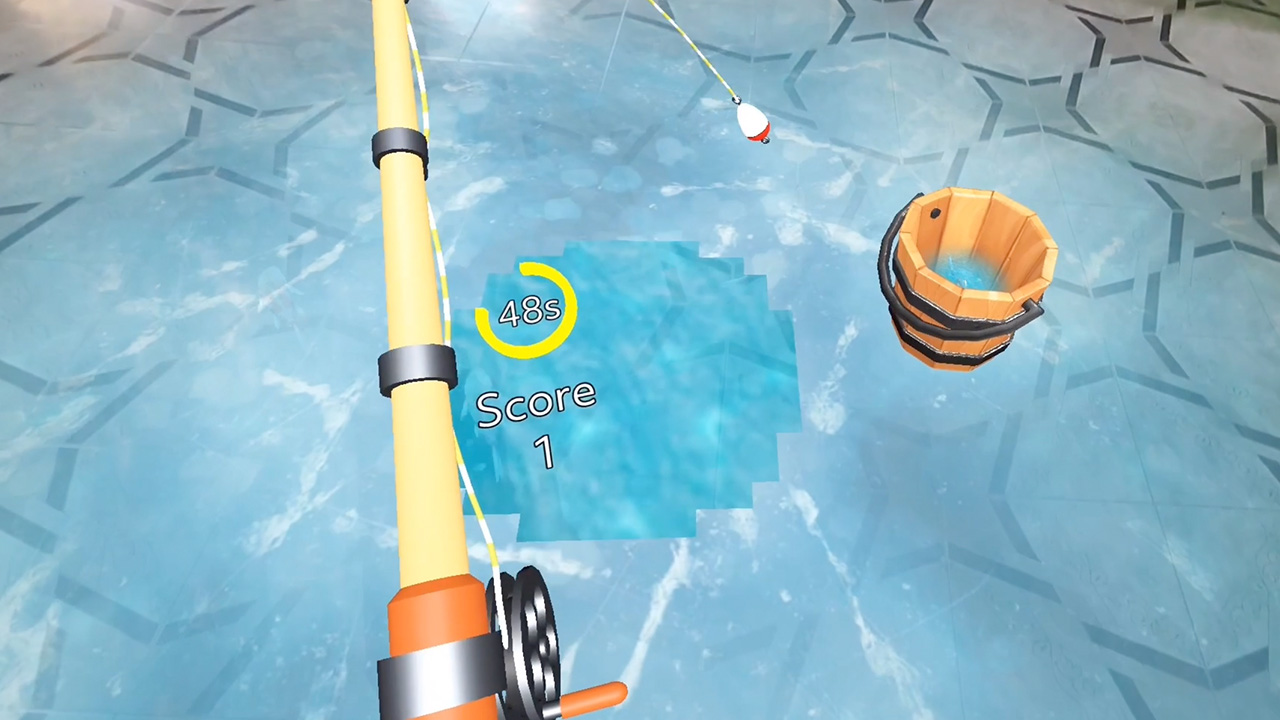
When you put on the Spectacles, a frozen lake appears in the real space around you. The ice sits on the floor. A hole opens at the centre. Below the surface, in the space that occupies the physical floor, fish move through the dark water.
You hold your phone in one hand. Scrolling up on the screen lets the line down through the ice. Scroll down, you reel it in. A fish bites. You feel resistance. Reel harder. Sixty seconds to catch as many as you can.
The Spectacles handle the spatial layer (lake, ice, water, fish, line) and the phone handles the tactile interaction. It is one experience across two devices, but to the person holding it, it feels like one thing. That was the brief.
The technical problem
The experience runs three computationally heavy systems at once: real-time shaders for the ice and water surface, full hand tracking (so the Spectacles always know where your hands are in space, even with a phone in one of them), and the fish simulation with underwater movement, bite detection, and line physics.
Any one of those alone is manageable. All three on the same frame budget is a different problem. The first build ran everything at full quality and hit immediate performance issues: frames dropped, the ice surface stuttered, and the fish felt disconnected from the interaction because the lag between reel input and fish response broke the feeling of weight.
The fix was not to pick which system to cut. It was to strip each system back to its minimum viable quality and then tune them against each other. The ice shader runs at lower resolution than it looks: a limited sample count that produces the feel of depth without the full cost. Hand tracking runs in a reduced detection zone: the area where your hands actually are during the experience, not the full spatial field. The fish simulation runs at a lower tick rate for idle fish (the ones you cannot see clearly) and at full rate only for the fish on the line.
The combined load fits in the performance ceiling. The experience runs smooth. Nobody who has played it has ever mentioned performance. That invisibility is the goal.
Featured at Snap events
Ice Fishing has been demonstrated at multiple Snap Spectacles events and featured in Snap developer content. At those events, the thing that consistently happened was people who had never used AR glasses before walked up, picked up the phone, and started fishing within thirty seconds without being told what to do. The fishing rod metaphor did the onboarding.
That pattern (pick up, understand immediately, engage) is what you are hoping for with any public-facing AR installation. Most experiences do not achieve it. Ice Fishing did, not because it was technically impressive (though the performance work was hard) but because the central metaphor was already familiar. Everyone knows what a fishing rod feels like.
What we learned
People do not instinctively know what to do in a new medium. This is the problem that sits behind most AR activations that underperform: technically correct, physically present, but the audience does not know what to do with it and does not feel comfortable enough to explore without prompting.
The standard response to this is more onboarding: tutorial overlays, instruction screens, a staff member next to the installation explaining it. These all work to some degree but they all add friction, and they all start from a position of assuming the technology needs explaining.
Ice Fishing started from the opposite position: if the technology needs explaining, the interaction needs rethinking. The phone-as-fishing-rod is not clever because it is technically original. It is clever because it removes the explanation entirely. The user's muscle memory already knows what to do. The glasses deliver the spatial layer they could not have imagined before they put them on, but the mechanism for interacting with it is one they have used their whole life.
This is the principle we carry into every spatial project now: the interaction model should borrow from somewhere the user already lives. The new thing should be what they see, not what they do. When the action is familiar and the world responds unexpectedly, that is when AR feels like something worth seeking out rather than something to get through.
The design principle, stated plainly
Make the interaction familiar. Make the world surprising. If those two things are reversed (a novel interaction and an expected world) you have a tutorial problem. People will stand outside the experience asking what they are supposed to do. If the interaction is familiar and the world is surprising, they are already inside it before they know it has started.
See the full build at the Ice Fishing case study. For the broader design principles behind Spectacles experiences, see designing for smart glasses.
Insights newsletter
Smart glasses, AR campaigns, spatial computing.
Straight to your inbox. No noise.
SubscribeFrequently asked questions
What is Ice Fishing on Snap Spectacles?
Ice Fishing is a hyper-casual AR game built for Snap Spectacles. The experience places a frozen lake in real space around you. Your physical phone becomes the fishing rod: scroll up to cast, scroll down to reel in. Digital fish appear beneath the ice and the goal is to catch as many as you can in sixty seconds. It was built as an experimental project to explore what the phone-as-controller interaction model opens up when combined with a Spectacles spatial AR display.
What was the hardest technical challenge in building Ice Fishing?
Running shaders, hand tracking, and the underwater fish simulation simultaneously on a single frame budget was the hardest constraint. Each of those systems is independently heavy. Getting all three to coexist at a frame rate that felt smooth required stripping each system back to its minimum viable quality, then tuning them against each other until the combined load fit within the performance ceiling Spectacles allows. The performance pass took as long as the core interaction build.
What did Ice Fishing teach you about designing AR for people who have never tried it?
People do not instinctively know what to do in a new medium. The standard response is more onboarding: tutorial screens, instruction overlays, help prompts. That approach backfires because it puts the new thing in front of people before they have a reason to care. Ice Fishing used a physical metaphor instead: holding a phone like a fishing rod is something everybody already understands. The interaction was already familiar when they picked up the glasses. The lesson is that the fastest way to make a new medium feel natural is to anchor it in something people already know how to do.