What agentic development means in Lens Studio
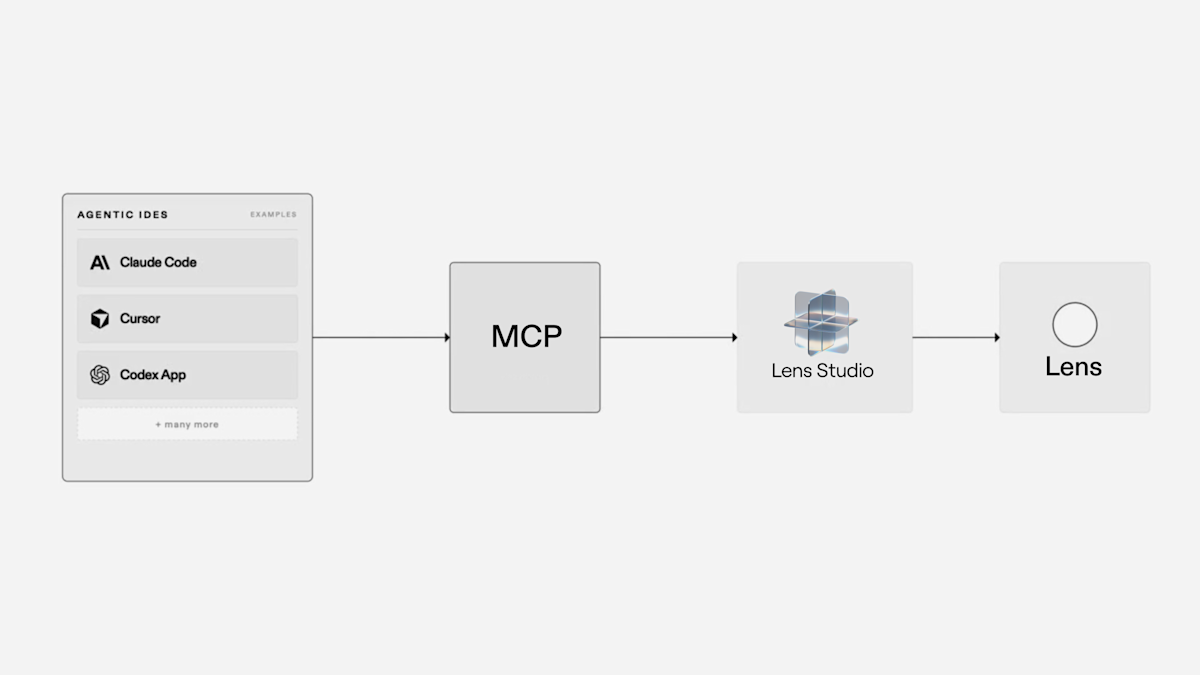
Agentic development is not autocomplete. It is a Lens Studio agent that can explore your project, suggest implementations, prototype interactions, run tests, and help debug without you switching between Lens Studio and a separate AI tool. The developer preview Snap launched at AWE runs inside Claude Code, Codex, and Cursor, meaning if you already use one of those environments, the Lens Studio agent drops into a context you already work in.
The agent handles the parts of Lens development that are repetitive and time-consuming but not creatively interesting: boilerplate TypeScript, component wiring, SnapOS API calls for hand gesture events, spatial anchor initialisation. It leaves the creative decisions and spatial logic to the developer. That division of labour is the right one for a studio building client experiences, where the interesting problem is always the user moment, not the SDK plumbing.
For studios that have already been building on Spectacles or Snap Specs, this shortens the gap between brief and testable prototype significantly. We have been building on Snap glasses since MIT Reality Hack 2026, where our spatial AI workbench Noodle won the competition. The bottleneck in that build was not the idea. It was the time between idea and something physical enough to test on the hardware. A Lens Studio agent that can scaffold a prototype in minutes instead of hours changes that ratio in ways that matter for project timelines.
The SPECS Spatial Benchmark: testing AI where it actually matters
The SPECS Spatial Benchmark is the most technically interesting announcement from AWE alongside the hardware launch. It exists because standard LLM benchmarks test language fluency, code generation, and reasoning on abstract problems. None of them test whether an AI model can reason about spatial layouts, coordinate systems, object relationships in three-dimensional space, or how digital content should respond when the physical environment changes.
For AR development, that is the missing piece. When you ask an AI coding tool to help you anchor a label to a product on a shelf, the model needs to reason about depth, about what happens when the camera angle changes, about how confidence scores from hand tracking should affect the label position. Current general-purpose models vary enormously in how well they handle this. Most developers building AR experiences have figured this out empirically through failed prototypes.
The Spatial Benchmark gives the developer community a common language for comparing how different AI models perform on tasks that actually matter for spatial development. It covers layout reasoning, coordinate understanding, object relationship assessment, and dynamic response to environment changes. If you are evaluating which AI coding assistant to use for Specs development, this benchmark is the right starting point, not a general coding benchmark.
Native Development Kit: C and C++ in Lenses
Lens Studio has historically been JavaScript and TypeScript territory. The NDK changes that by allowing developers to write C and C++ code for performance-critical sections of a Lens. The functions it targets are exactly the ones where TypeScript hits a wall: spatial mapping, real-time physics, audio processing, networking, and navigation.
For most brand activation work, you will not need the NDK. A sponsored Lens with a spatial overlay and hand gesture interaction is well within what TypeScript can handle at the performance requirements of a 4-hour event activation. But for more demanding experiences, such as real-time spatial mapping in a large crowd environment, audio-reactive AR that processes a live feed, or navigation experiences that render turn-by-turn directions anchored to real streets, the NDK removes the ceiling that JavaScript previously imposed.
The practical impact for studio work is that experiences which previously required a custom native application, with all the device compatibility and distribution complexity that entails, can now potentially be built and distributed as Lenses. That is a meaningful shift in what is achievable within the Snap ecosystem.
Migration Agent: getting Unity projects to Lens Studio
A lot of studios with existing spatial and XR experience have large Unity codebases. Lens Studio uses a different architecture, and the work of porting between them has historically been done by hand, which is slow and requires developers who know both environments deeply.
Snap's Migration Agent automates the structural conversion: project architecture, asset references, and visual components transfer from the Unity project structure to Lens Studio. It will not handle every edge case automatically, and complex physics simulations, custom shaders, or deeply Unity-specific patterns will need manual follow-through. But it reduces the starting cost of moving an existing spatial experience onto Specs hardware, which lowers the barrier for studios evaluating whether to bring an existing experience to the platform.
For a studio considering building a Specs activation based on an experience they previously built in Unity for a different context, the Migration Agent makes that evaluation faster. You can get a rough port running and test it on Specs hardware before committing to a full rebuild, rather than estimating from a code audit alone.
What this means for studios building brand experiences
The tools Snap launched at AWE are not primarily for consumer Lens creators. They are for studios and developers building production-quality experiences, the kind that need to work reliably in front of a live audience with no developer standing next to the user.
The combination of agentic development and the Spatial Benchmark changes the economics of prototype work. Getting from a brief to a testable prototype on hardware used to take two to three weeks of setup before a single real interaction could be tested. With an agent that can scaffold the Lens structure and a benchmark to evaluate which AI models are actually useful for spatial reasoning, that window compresses. Which means more of the project budget can go into the experience design and environment testing that actually determines whether a production activation works, rather than the scaffolding work that precedes it.
Summary: what Snap launched for Specs developers at AWE 2026
How to get access
The agentic development preview is available now for developers building on Specs. Access through the Claude Code, Codex, or Cursor integrations requires opting into the developer preview via the Snap Developer Portal. The SPECS Spatial Benchmark is also available now for evaluating AI model performance on spatial tasks. Developers can test prototypes on physical Specs hardware at Snap studios available in key cities, or using the Specs emulator within Lens Studio.
If you are a studio evaluating whether to build a Specs activation for a brand client, the right question is not whether the tools are ready. They are. The right question is whether you have the spatial design experience to use them on a production timeline. Tools reduce the technical cost of building. They do not substitute for knowing how to design an experience that works on real users in a real environment. See our piece on the use case problem that kills most smart glasses experiences before a line of code is written.
For studios ready to build: the Fall 2026 ship date for Specs sets the activation window. The brief-to-build timeline for a production Specs experience is 8 to 12 weeks. That clock starts now.
Frequently asked questions
Does Snap Specs work with Claude Code?
Yes. Snap launched agentic development for Lens Studio at AWE 2026, with a developer preview available in Claude Code, Codex, and Cursor. The integration brings Lens Studio agents and skills into those environments so developers can prototype, test, and debug Specs Lenses without leaving their existing tools. The developer preview is available now.
What is the SPECS Spatial Benchmark?
The SPECS Spatial Benchmark is a testing framework Snap launched at AWE 2026 to measure how AI models perform on real-world spatial tasks: layout reasoning, coordinate understanding, object relationships, and how digital content should respond to physical environment changes. It exists because general LLM benchmarks do not test the spatial reasoning that matters for AR development.
Can I port a Unity project to Lens Studio for Snap Specs?
Snap's Migration Agent, launched at AWE 2026, automates the structural conversion from Unity to Lens Studio, covering project architecture and visual components. Complex Unity-specific patterns will still need manual follow-through, but the agent significantly reduces the starting cost of porting an existing Unity experience to the Specs platform.
What is the Native Development Kit for Snap Specs?
The Native Development Kit (NDK) allows developers to write C and C++ code directly into Lenses for performance-critical functions: spatial mapping, physics simulation, audio processing, networking, and navigation. For experiences that push the performance ceiling of JavaScript, the NDK removes that ceiling entirely.
Insights newsletter
Smart glasses, AR campaigns, spatial computing.
Straight to your inbox. No noise.
SubscribeBuilding a Specs experience for a brand?
We have shipped on Snap glasses hardware. We can help you move from brief to tested prototype before Fall 2026.
Start a projectReplies within 48 hours, straight from the studio.