In short: pick one mechanic, keep the loop short, give the player a number to post, and make the brand the thing they are playing with. Everything else is polish.
Why games outperform static AR filters for brands
A static filter is used once. A game is used until the player beats their score, then sent to a friend so the friend can try. That second step is the distribution. It is the same participation mechanic we break down in how AR campaigns earn organic reach: the audience does something, gets a result, and posts the result because it says something about them.
Platforms have noticed. At Lens Fest in October 2025, Snap reported that more than 175 million people play Lens Games on Snapchat every month. Lens Studio ships game components such as a leaderboard and turn-based play, and live multiplayer matchmaking arrived in Lens Studio 5.24 in September 2026. A game Lens is not a niche format any more. It is one of the main reasons people open the camera.
Kavin has developed AR games for Benefit Cosmetics, Old Spice, M&S, Universal Music, Great British Bake Off, Full Time Meal, and an ocean conservation NGO, plus Ellen's Heads Up! for Messenger, often working alongside agency partners. On M&S and Universal Music he was creative director as well as developer. Ice Fishing on Spectacles is the studio's own game. The mechanics below come from that work.
The six game mechanics that work in a camera filter
1. Face-controlled games
The face is the controller. Blink, open your mouth, move your nose, raise your eyebrows. No hands, no taps, and the player's face stays in frame the whole time, which is what makes the recording worth posting.
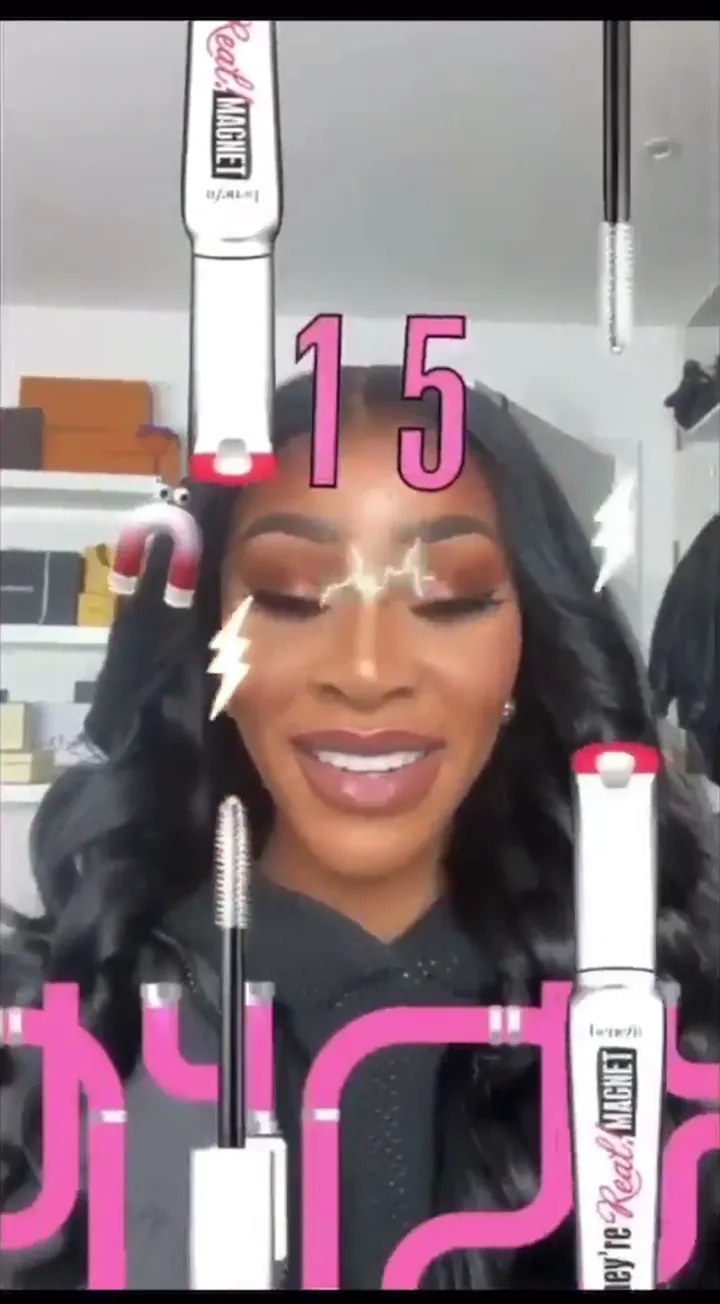
- Benefit Brow Game: an Instagram AR game where face tracking detects blinks to steer a floating magnet, Flappy Bird-style, through electric obstacles to unlock a prize.
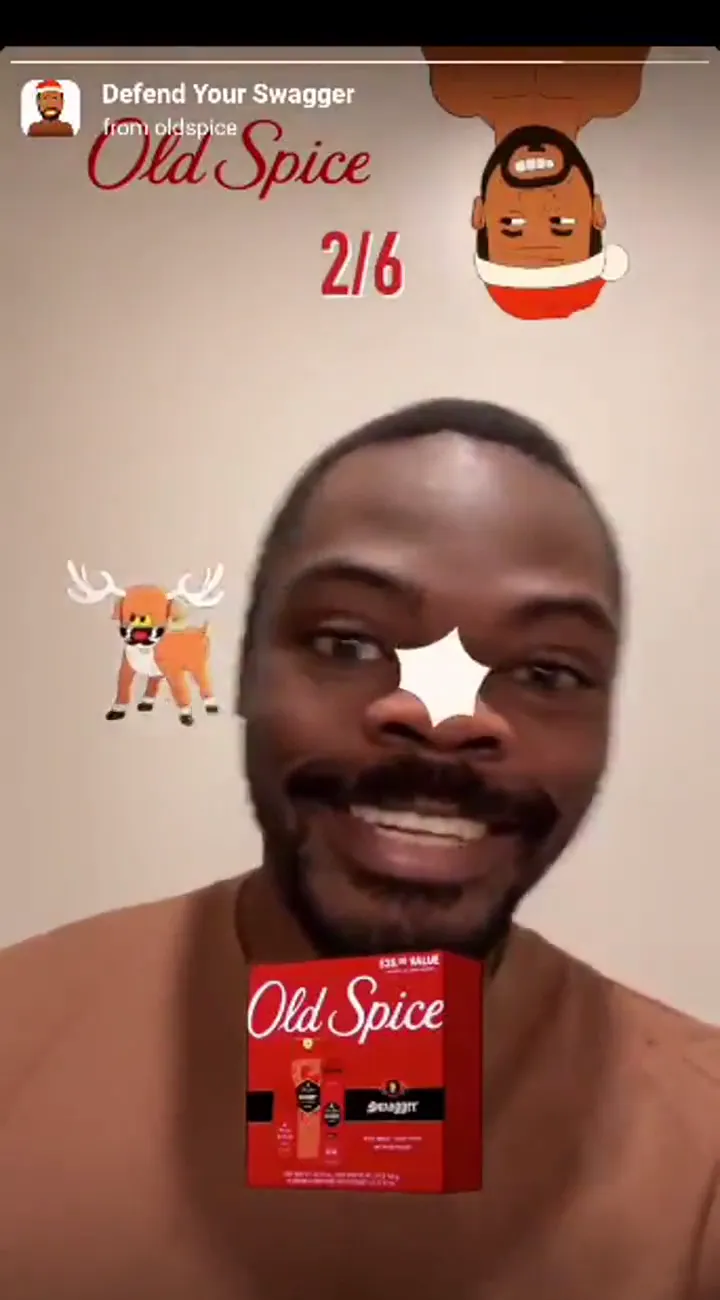
- Old Spice Nose Game (via Simone Agency): objects rain down on an Old Spice bottle and you hit them away with your nose. Physical, absurd, and on-brand for Old Spice's tone.
- Full Time Meal: a Snapchat Lens where food falls from the top of the screen and you catch it by opening your mouth. Face tracking controls the entire game.
Face games are the safest starting point. Everyone already knows how to blink. The failure state is built in, because a player straining their face to dodge an obstacle is funny whether they win or lose.
2. Endless runners and tap games
The player keeps going until they hit something. One input, rising speed, a distance or score at the end. Runners work because a single round can be ten seconds or a minute depending on skill, and every death is a reason to go again.
- Universal Music Endless Runner (via Augit agency): an Instagram AR runner where players keep going while the promoted track plays. The song is part of the mechanic, so every round is another listen.
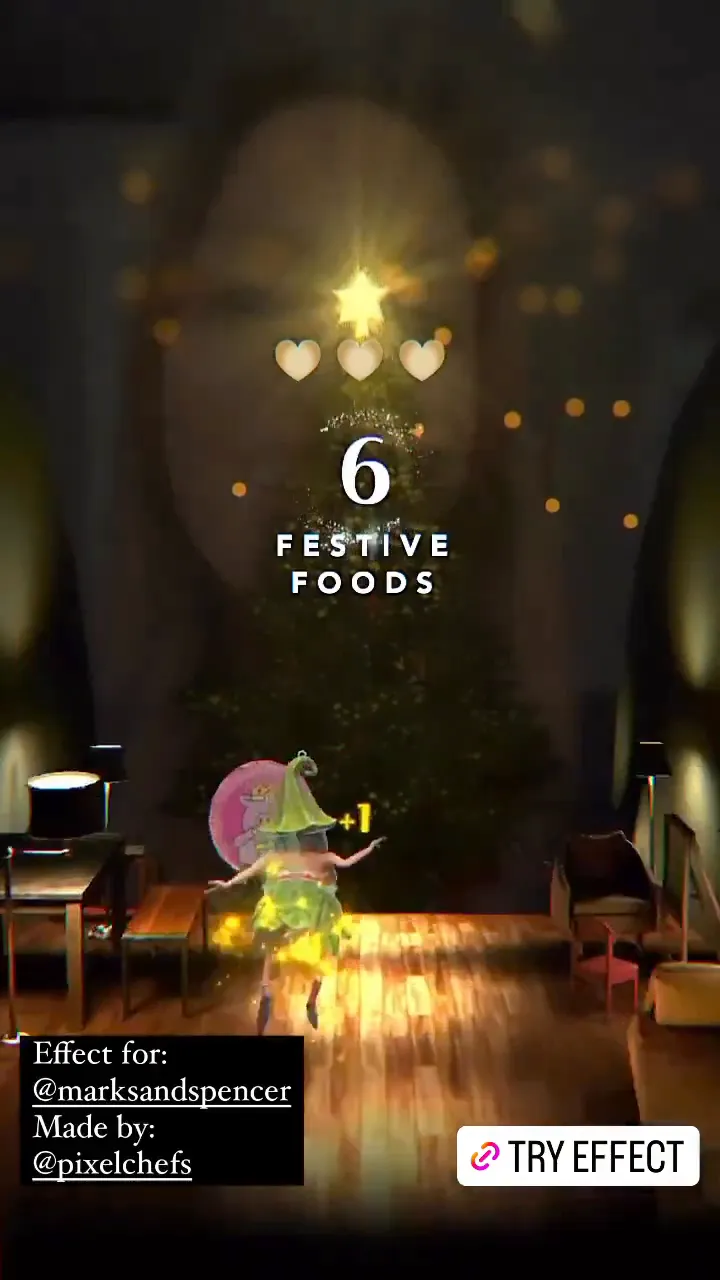
- M&S Fairy Game (via Pixel Chefs agency, in partnership with Meta): guide a fairy through an M&S world, collect products, dodge obstacles. Your score decides the custom discount coupon you unlock at the end.
The M&S build is the clearest example of a score that matters outside the game. A better run earns a better coupon, so the replay has a commercial reason behind it, not only bragging rights.
3. Randomisers
Not every game needs skill. A randomiser spins and lands on a result: which character you are, which flavour, which team. The share comes from identity, not score. The Bake Off Dessert Randomiser for Great British Bake Off spins a wheel that stops on a dessert, then morphs the player's face into that dessert. People share the result because the result is them.
Randomisers are cheap to replay. Players spin again to see what else they could have got, and the format suits TV, entertainment, and launches with a cast of characters.
4. Catch and collect
Items appear, the player gathers them. It is the most flexible mechanic for a brand because the items can be products, ingredients, or the problem the campaign is about. The Ocean Cleaning AR Game for an ocean conservation NGO transports the player underwater to collect garbage bags and oil drums. The message is the mechanic: your actions in the game mirror the real cleanup effort.
5. Timed challenges
A hard clock changes how people play. Thirty or sixty seconds, as many as you can. A fixed length keeps every round comparable, which makes scores worth comparing, and it caps the session so nobody gets bored before the end card. Ice Fishing, our Spectacles game, gives the player sixty seconds to catch as many fish as they can.
6. Social and party games
Some games need two people. Ellen's Heads Up! Messenger AR, built with Ellen DeGeneres and Meta while Kavin was AR developer at Nexus Studios, put the party game into Messenger video calls: one player has a category card above their head that only the others can see, and they guess from reactions in real time. Snap has moved the same way: turn-based games you play by sending a Snap, and since Lens Studio 5.24 (September 2026) live multiplayer matchmaking for real-time games. We cover the formats in multiplayer and shared AR for brands.
What makes people replay an AR filter game and share it
Across those builds, the games that travel share four traits. Brief for all four.
- A short loop. Keep one round under about 30 seconds for most formats. Social video is short, and the recording should hold the whole round, including the ending.
- A score to beat. Show the number big on the end screen so it reads in the recording. A friend's score is the best invitation to play there is.
- A funny failure state. Most rounds end in failure. If losing looks good on camera, the losing rounds get posted too, which is most of them.
- The brand inside the mechanic. Old Spice is the bottle you protect. M&S products are the things you collect. The Universal track is the soundtrack you run to. Take the logo off and the game would no longer make sense. That is the target.
If the brand could be swapped for any other brand without changing the game, the brand is decoration. Players feel that, and they do not share decoration.
The onboarding rule matters as much. When we demoed Ice Fishing, people who had never used AR glasses picked up the phone and started fishing within thirty seconds without instructions, because everyone knows what a fishing rod does. A filter game has even less time. If the first frame needs a tutorial, rethink the input.
Snapchat, TikTok or Instagram: where a branded AR game can run in 2026
Snapchat is the strongest home for a branded game. Lens Studio has dedicated game tooling, including leaderboard, turn-based and live multiplayer components, and games already have a large regular audience. See our guide to custom Snapchat filters for brands for how a Lens build runs.
TikTok game effects are built in Effect House with face, body, and gesture tracking. The game is recorded into a video, so the score and the failure become the post, and TikTok's feed can surface that video to people who never searched for the brand. The process is covered in how to create TikTok AR effects for brands.
Instagram is no longer an option for a commissioned game. Meta shut down Meta Spark on January 14, 2025 and removed AR effects built by third-party creators from Instagram, Facebook, and Messenger. Only effects made by Meta's own team remain. Meta Spark was the only tool for publishing third-party AR effects on Instagram, so every Instagram game above (Benefit, Old Spice, M&S, Universal Music) dates from before the shutdown. If a brief still asks for an Instagram AR game, the realistic options are a Snapchat or TikTok build, or a WebAR game that runs in the browser from a link in an Instagram story or bio.
WebAR is also the answer when the game belongs to the brand's own channels, packaging, or an event screen. Live browser demos are at ar.rbkavin.studio. For crowd-scale versions at venues, see stadium AR for sports events.
How much an AR filter game costs
Games sit in the interactive tiers of our standard pricing, because they need game logic, states, and more testing than an effect you only look at. Using the ranges in how much an AR filter costs (USD, production only, media excluded):
| Game type | Typical platform tier | Range |
|---|---|---|
| Simple face game or randomiser | Snapchat face effect with 3D asset or animation | $6,000 to $10,000 |
| Runner, collect, or timed game with scoring | Snapchat multi-state Lens with interactive elements | $12,000 to $22,000 |
| TikTok game effect | Mid-tier to complex Effect House build | $8,000 to $25,000+ |
| WebAR game | Focused to complex browser build | $8,000 to $25,000+ |
The biggest cost drivers are the same as any filter: 3D assets made from scratch, the number of game states, and short timelines. A rewards layer, like the M&S score-based coupon, adds logic and testing on top. Bringing existing 3D product models into the brief is the fastest way to bring the number down. For what moves a branded build up or down, see branded AR filter: cost and brief.
Plan for five to seven weeks from brief to live on Snapchat, including five to ten business days of review. On TikTok, six to nine weeks is typical, including one to two weeks of review.
How to brief an AR filter game
A good game brief is short. It answers six questions:
- The one input. Blink, mouth, tap, tilt, or nose. One. Two at most.
- Where the brand lives in the mechanic. Is the product the hero, the obstacle, the collectible, or the reward?
- Round length. A target in seconds, ideally under 30 for social.
- The end screen. What number or result the player sees, and whether it unlocks anything, such as a coupon or a prize.
- Platform and channel. Snapchat, TikTok, WebAR, or a live event. Each changes the tooling and the review path.
- What success means. Plays, shares, replays per user, or redemptions. Agree it before the build so the game is designed to move that number.
Leave the visuals open. The studio's job is to find the mechanic that makes your brand fun to play with. If you already know the mechanic, say so. If not, give us the product truth and the audience, and we will come back with game concepts before anything is built.
Games on smart glasses: what Ice Fishing taught us
The same rules apply when the game moves from the phone screen to the room. Ice Fishing is a hyper-casual game we built on Spectacles, the developer platform behind Snap Specs (formerly Spectacles). A frozen lake appears on the floor, the phone becomes the fishing rod, and the player has sixty seconds to catch as many fish as they can. It was featured at Snap Spectacles events, where first-time users understood it without being told what to do.
It follows every rule above: one familiar input, a fixed clock, a score, and a physical metaphor that does the onboarding. The full build story is in building Ice Fishing for Snap Spectacles, and our wider glasses work is on the wearables page. For brands planning event activations, a glasses game is the next step after a filter game, not a different discipline.
Frequently asked questions
What is an AR filter game?
An AR filter game is a camera effect on Snapchat, TikTok, or the web that the player controls with their face, body, or a tap, and that ends in a score or result. Common formats are face-controlled games, endless runners, randomisers, catch-and-collect games, and timed challenges. The player records the round and shares it, which is how the game spreads.
How much does a branded AR filter game cost?
A simple face game or randomiser on Snapchat typically costs $6,000 to $10,000 in production. A runner, collect, or timed game with scoring sits in the multi-state tier at $12,000 to $22,000. TikTok game effects and WebAR games run from $8,000 to $25,000+. Paid media is a separate budget.
Can brands still make Instagram AR games?
Not as a commissioned Instagram effect. Meta shut down Meta Spark on January 14, 2025 and removed AR effects built by third-party creators from Instagram, Facebook, and Messenger, keeping only effects made by Meta's own team. Brands that want a game for an Instagram audience now build on Snapchat or TikTok, or build a WebAR game and link to it from Instagram.
Is Snapchat or TikTok better for a branded AR game?
Snapchat has the deeper game tooling, including leaderboard, turn-based and live multiplayer components in Lens Studio, and Snap reported in October 2025 that more than 175 million people play Lens Games every month. TikTok suits games built to be watched, because every round becomes a video the feed can surface to new viewers. Pick the platform where your audience already spends time, then design the mechanic for it.
How long should one round of an AR filter game last?
Aim for under about 30 seconds for most social formats. A short round fits inside a single recording, including the end screen with the score, and makes replaying feel cheap. Timed challenges of 30 or 60 seconds work well because every round is the same length, so scores are worth comparing.
How long does it take to build an AR filter game?
Plan for five to seven weeks from brief to live for a scored Snapchat game, including five to ten business days of review. TikTok builds typically take six to nine weeks, including one to two weeks of review. Leave at least a two-week buffer before any hard launch date so one revision request does not move the campaign.
Insights newsletter
Smart glasses, AR campaigns, spatial computing.
Straight to your inbox. No noise.
SubscribeWant a game people play twice?
Tell us the product, the audience, and the platform. We will come back with game mechanics built around your brand, not on top of it.
Start a project