Light, shaped in software,
to fit the real thing exactly.
In short: projection mapping is light from a projector that's digitally shaped in software to match a real surface's exact edges, so it looks painted onto a building or object instead of a flat rectangle placed over it. It isn't AR: there's no phone, headset, or app, you just look at it directly like a light show. Tap the building below.
This is not AR
Both add digital visuals to the real world. Only one needs something in your hand or on your face to see it.
Three steps before the light ever turns on
The surface never changes. Everything else happens in software, long before opening night.
See it done for real
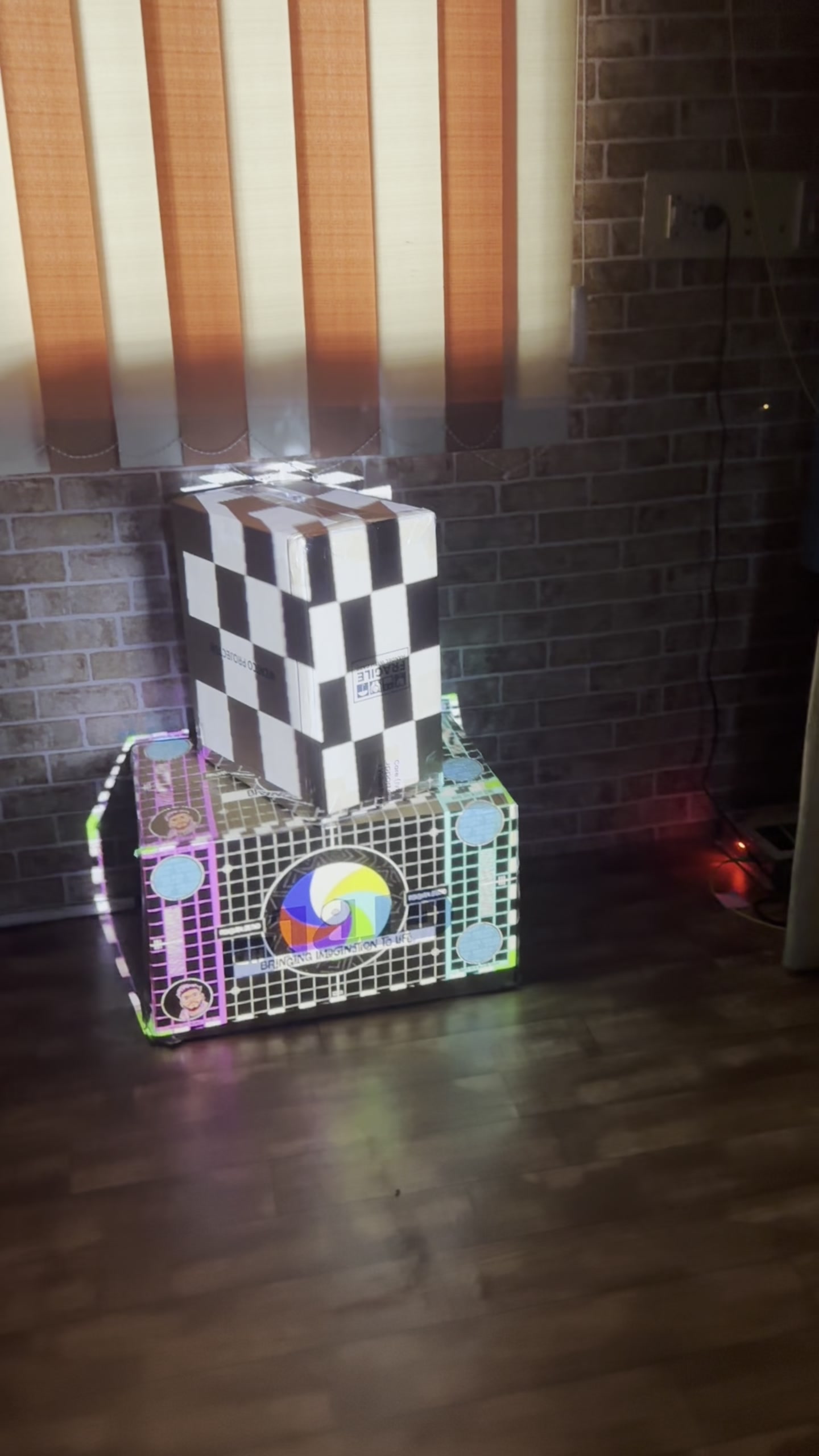 A studio projection mapping test
Graphics warped in software to follow two stacked boxes exactly, edge for edge, the same idea a building facade uses at a much bigger scale.
Read the full guide and see the demo →
Another live, physical format
An AR mirror also adds digital content in real time with nothing to hold. A screen and hidden camera instead of a projector and light.
What is an AR mirror? →
A studio projection mapping test
Graphics warped in software to follow two stacked boxes exactly, edge for edge, the same idea a building facade uses at a much bigger scale.
Read the full guide and see the demo →
Another live, physical format
An AR mirror also adds digital content in real time with nothing to hold. A screen and hidden camera instead of a projector and light.
What is an AR mirror? →
Tell us the surface and the brief.
We'll tell you what mapping it takes.
Start a project
6 years directing AR campaigns, official Snap & TikTok partner. Replies within 48 hours.
Quick answers
Is projection mapping the same as AR?
No. Projection mapping uses a projector to shape light directly onto a real surface, so anyone standing there sees it with their own eyes, no device required. AR needs a phone or glasses to add the digital layer, without one there is nothing to see.
Do you need an app or headset to see projection mapping?
No. It is light hitting a real surface, visible to anyone in the room exactly like a light show. There is nothing to download, hold, or wear.
What kinds of surfaces can be projection mapped?
Almost any solid surface: a building facade, a stage set, a product on a table, even an irregular sculpture. The more precisely its shape is scanned, the tighter the mapped content fits.
How does the light fit an object's shape so exactly?
Software takes a 3D scan or model of the surface and warps the video content pixel by pixel to match it, before the projector is calibrated to the exact distance and angle on-site.