In short: entertainment AR works because it turns a passive audience into a participant, and a participant shares what they made, not what they watched.
A trailer asks nothing of the person watching it. A poster asks even less. Both are proven formats, and both still have a place in every release plan. But six years of directing AR campaigns for entertainment clients, including HBO's House of the Dragon and, more recently, the WebAR launch activation for 007 First Light, has taught me that AR does a specific job that no other format in the marketing plan can do: it puts the audience inside the property, physically or virtually, before they have seen a single scene of the actual story.
That distinction matters most for creative directors and producers deciding whether a title launch needs an AR specialist at all, or whether the standard social rollout will cover it. This article walks through what AR uniquely does for entertainment marketing, using two real campaigns as the evidence, and then breaks down how to choose between the two dominant formats: a Snap Lens and a browser-based WebAR filter.
What entertainment AR does that trailers and posters can't
Four capabilities separate AR from the rest of an entertainment marketing plan. Not every campaign needs all four, but every AR brief should be evaluated against them before greenlighting a build.
Character immersion
A poster shows you a character. AR puts you inside their frame, their costume, or their world. That shift from looking at a character to occupying their space is what makes an AR experience feel personal in a way a static asset cannot. The audience is not being told a story is good; they are being handed a small, direct piece of proof.
Spoiler-free reveals
Marketing teams for any title with a plot worth protecting face a constant tension: build hype without giving away the story. AR resolves this cleanly, because it can deliver a strong emotional connection to a property using only its iconography, not its narrative. A dragon at a real-world location or a franchise-defining visual motif carries meaning without revealing a single plot beat. This is a genuine advantage over any trailer cut, which by definition has to show footage.
Cast and character voice integration
Where a platform and IP rights allow it, AR experiences can carry a character's voice directly into the interaction, whether that is a triggered audio line, a narrated moment, or a voice-reactive effect. Voice is one of the fastest ways to make an AR moment feel authored rather than generic, because it signals that the studio itself is speaking to the fan, not just licensing an asset to a marketing vendor. Not every brief needs this layer, and it usually adds both cost and an extra approval cycle, but it is worth raising early if the property has a strong vocal identity to draw on.
Fandom-driven organic sharing
The mechanism that makes AR efficient at scale is straightforward: people share things they made, not things they merely watched. A trailer view ends in a swipe. An AR moment ends in a saved photo, a shared clip, or a tagged friend, and each of those is a small act of distribution that a media budget did not pay for directly. This is the reason AR consistently produces reach-per-dollar numbers that a comparable paid media spend cannot match for entertainment titles specifically, because entertainment audiences already want an excuse to signal fandom publicly.
Case study: House of the Dragon and the Snap Lens that found you
When Snapchat partnered with AR creators worldwide for the global launch of House of the Dragon Season 1, the brief was a location-based lens tied to a real landmark, discoverable inside Snap Map. Rather than anchoring a dragon to an obvious famous monument, the House of the Dragon AR campaign chose Sankagiri Hill Fort in Tamil Nadu, a crumbling brick fort whose visual weight already matched the show's world. The dragon slept until a user's proximity woke it. No UI, no prompt, just the environment and the behaviour.
The lens ran on Snapchat Lens Studio as part of Snapchat's broader multi-creator campaign: roughly 20 landmarker lenses across 10 or more countries, reaching into a platform with 250M+ daily AR users. This single lens generated 100K+ impressions across geofenced cities during premiere week alone.
A sleeping dragon that reacts to how close you are is a relationship, not a demo. Proximity turned the user's own movement into the story.
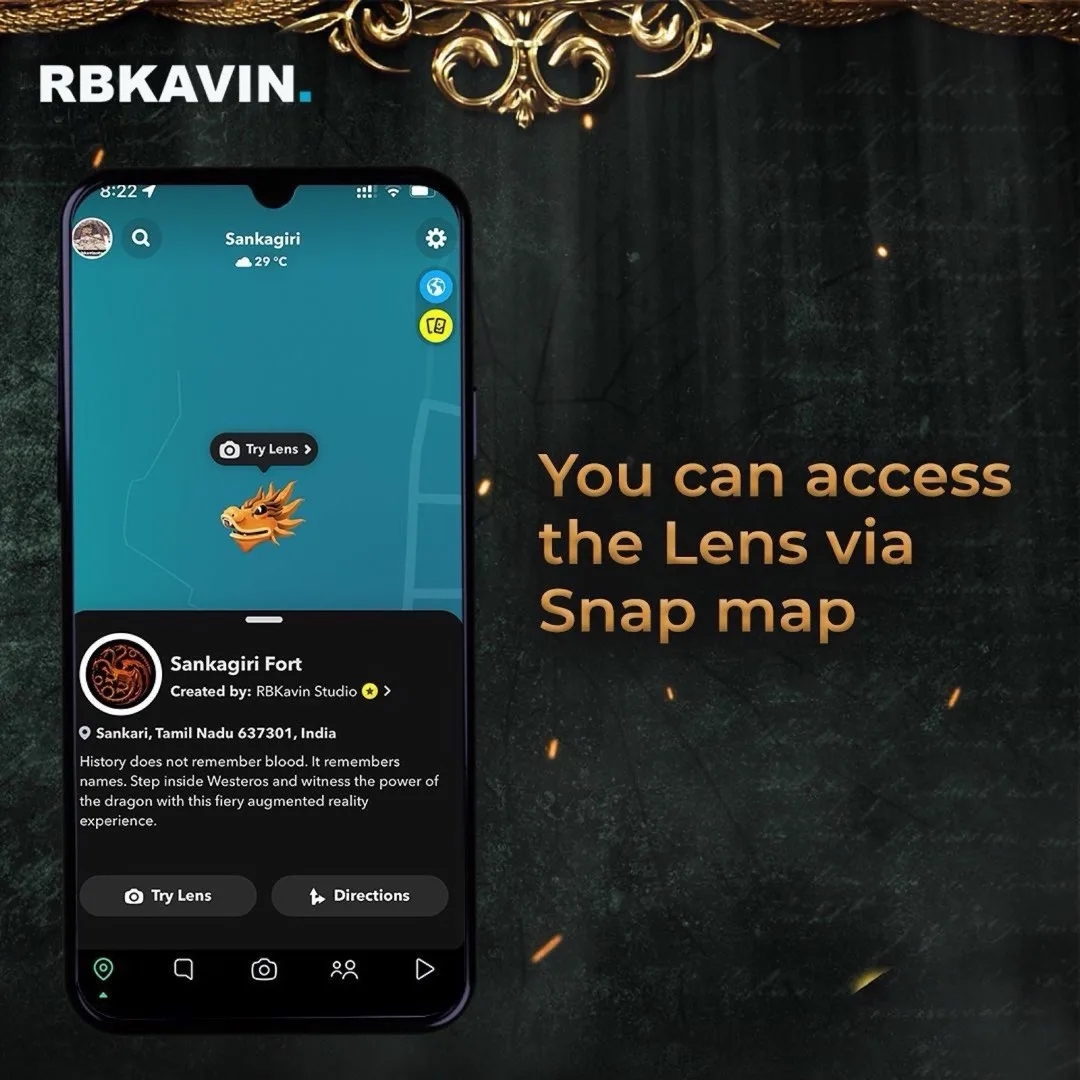
The location choice was the most important creative decision on the project, not the dragon model itself. A famous monument already carries its own narrative; the fort chosen for this campaign had none competing with the show's, which gave the AR room to feel inevitable rather than applied. That lesson, that the physical or platform context often carries more storytelling weight than the AR asset does, is one this article returns to in the format section below.
Case study: 007 First Light and the WebAR gunbarrel moment
For the launch of 007 First Light, IO Interactive's new James Bond game, agency Gloam Agency UK brought RBKAVIN. Studio in to build the campaign's WebAR component: a browser-based face filter that placed fans inside the franchise's most recognisable composition, the gunbarrel frame, ahead of the game's May 27, 2026 release. The 007 First Light WebAR activation needed to work on any modern phone with no app download, and produce shareable output in both vertical and square formats to cover Stories, Reels, and grid posts.
The gunbarrel spiral carries roughly 60 years of cultural meaning on its own. Putting the user's face at its centre made them the protagonist before they had played a minute of the actual game, using an asset that predates and has nothing to do with the specific plot of First Light. That is the spoiler-free reveal mechanic in practice: zero narrative content, full emotional connection to the franchise.
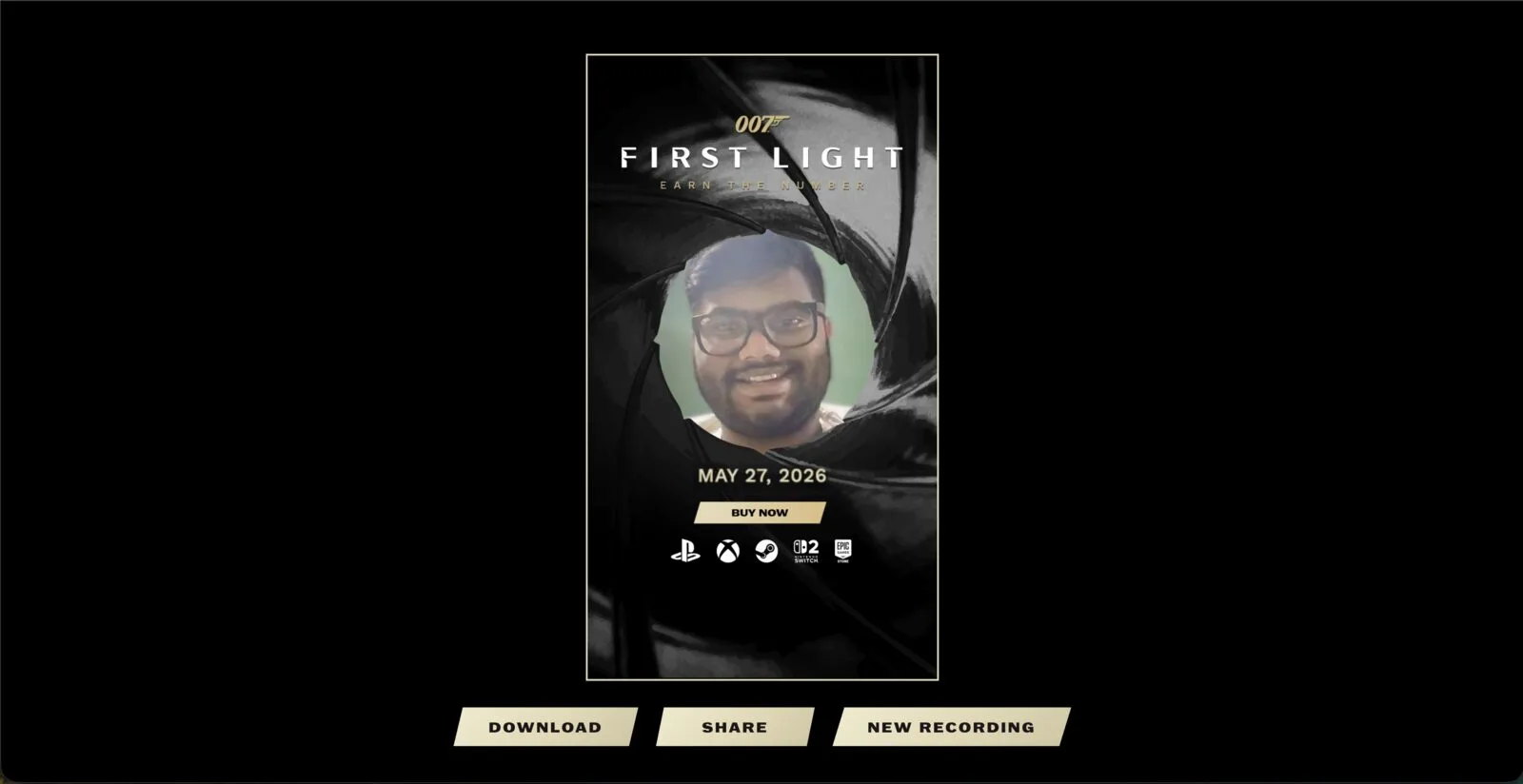
Because the experience ran through a browser rather than a platform-native lens, the format decision was as important as the AR build itself. Face tracking precision at a tight compositional frame, the cold-start delay before the camera locks on, and a two-click path from capture to native share sheet were the parts of the build that determined whether a user completed the experience or closed the tab. WebAR trades a platform's built-in audience for a link that works for literally anyone with a phone camera, which is the right trade when the campaign needs to reach people who will never open Snapchat or TikTok that day, such as a press junket, a game-launch landing page, or a QR code on physical packaging.
Snap Lens vs WebAR: choosing the format for a title launch
These two campaigns used different formats for a reason, and that reason is the actual decision a creative director or producer needs to make before writing the brief.
When each format fits
- Snap Lens: fits a discovery-driven, social-native moment. It lives inside a platform fans already open daily, and it can ride the platform's own discovery surfaces, such as Snap Map for a location tie-in. Custom builds on platform-native tools start from roughly $5,000.
- WebAR: fits a moment tied to a specific physical or campaign touchpoint: a poster, a ticket, a press event, a game-launch page. No app, no platform account, just a link or QR code in a browser. A solid interactive build typically runs $8,000 to $20,000.
- Both formats share this constraint: the frame or hook needs to be strong enough to carry the moment before any tracking or effects work begins. House of the Dragon's hook was the location. 007 First Light's hook was the gunbarrel. Neither campaign needed a complex build to work, because the concept was doing the heavy lifting.
The practical question to ask first is not "which format is more impressive" but "where does the audience already have their phone out, and what are they trying to do in that moment." A fan browsing Snap Map near a real-world landmark is in discovery mode, which favours a Lens. A fan who just saw a poster with a QR code, or is on a game's launch page counting down to release, is in a single-purpose moment, which favours WebAR. Getting this wrong produces a technically sound build that nobody encounters at the right time. For a fuller breakdown of formats across a full release window, including social AR, physical AR mirrors, and WebAR on packaging, see immersive storytelling for film and series promotions.
Briefing an AR specialist for a title launch
Agencies and studios that have not run an AR component before tend to ask the wrong first question, which is "what can AR do." The more useful first question is "what do we want a fan to feel in the ten seconds after they open this, and what real constraint, IP approval, launch date, or physical location, does that feeling have to work around." Both House of the Dragon and 007 First Light started from a concrete constraint: a real landmark in one case, a franchise-defining visual and a hard release date in the other. The AR format followed from the constraint, not the other way round.
Bring a specialist in early enough to make that call properly. A Snap Lens typically needs four to six weeks from an approved brief to platform submission, plus platform review time. A WebAR build with custom face tracking needs a similar window. Character or franchise likeness that requires studio sign-off adds another two to four weeks on top of either. Twelve weeks ahead of the first activation date is the safe minimum, and starting later than that is the single most common reason an entertainment AR component ships compromised.
Frequently asked questions
What can AR do for a film campaign that a trailer or poster can't?
AR puts the audience inside the world of the film rather than showing it to them. A trailer is watched. An AR lens is worn, entered, or triggered by walking somewhere specific. That difference is what drives organic sharing: people share things they were part of, not things they merely saw. It also lets a studio release a reveal moment, a character effect, or a location tie-in without showing a single frame of actual footage, which matters heavily for spoiler-sensitive titles.
Should a film campaign use a Snap Lens or WebAR?
It depends on where the moment happens and how much reach you need versus how tightly you need to control the frame. A Snap Lens fits a social, discovery-driven moment: it lives inside a platform fans already open daily and can piggyback on that platform's own audience and discovery surfaces like Snap Map. WebAR fits a moment tied to a specific physical or campaign touchpoint, such as a poster, ticket, or press event, because it needs no app and no platform account, just a link or QR code opened in a browser. House of the Dragon used a Snap Lens because the brief was location discovery inside Snapchat. 007 First Light used WebAR because the brief was a branded face filter that had to work for anyone with a phone browser, tied to a specific game launch date.
How much does an AR activation for a film or game launch cost?
A custom Snap Lens built on platform-native tools starts from roughly $5,000. A WebAR face filter or interactive browser experience typically runs $8,000 to $20,000 depending on tracking complexity and output formats. Costs rise with the number of layout variants, the amount of licensed IP asset work, and studio approval cycles for character likeness. Neither of the projects referenced in this article required custom native app development, which is the format that pushes budgets past $25,000.
Can AR reveal a character or location without spoiling the plot?
Yes, and this is one of AR's specific advantages over trailer-based marketing. An AR experience can put a fan inside a character's world, costume, or iconic frame without showing a single narrative beat from the actual story. House of the Dragon's lens showed a dragon at a real-world location, not a scene from the show. 007 First Light's filter placed the user inside the gunbarrel, a franchise signature that predates the specific plot entirely. Both delivered a strong emotional connection to the property with zero spoiler risk.
How far ahead should a studio or agency brief an AR specialist?
Twelve weeks before the first activation date is a safe minimum, and longer if the concept touches licensed character likeness or requires studio sign-off. A Snap Lens typically needs four to six weeks from an approved brief to platform submission, plus review time that varies by platform. A WebAR build with custom face tracking or multiple output layouts needs a similar window. The most common reason entertainment AR campaigns ship compromised is a brief that arrives after that window has already closed.
Does AR marketing only work for major franchises like HBO or Bond?
No. Both House of the Dragon and 007 First Light are franchise titles, but the mechanics that made each work, a strong locational or iconic hook plus a low-friction format, scale down to smaller titles. An indie film with one distinctive visual motif or a mid-budget series with a striking location can use the same Snap Lens or WebAR approach at a fraction of the production cost, because the format cost is driven by build complexity, not franchise size.
Launching a title and weighing up an AR component?
Six years of AR campaign direction, HBO and IO Interactive among the credits, and official Snap and TikTok partner status. Let's talk about the constraint your launch is actually working around.
Start a projectReplies within 48 hours, straight from the studio.
Related articles