Start with what it is not
Augmented reality is not virtual reality. This distinction matters because most people hear "AR" and picture a headset that covers their eyes: the image that dominated tech news for several years. That is VR: virtual reality, where the real world is replaced entirely with a simulated one. AR is the opposite. Your eyes stay on the real world. AR adds to it.
AR is also not a futuristic concept. It is already running on the phone in your pocket. Every Snapchat filter, every Instagram face effect, every IKEA furniture preview in your living room, every Pokémon you have ever seen placed on a real street. Those are all augmented reality. The technology is already part of billions of people's daily experience. The word just makes it sound more exotic than it is.
The simplest definition
Augmented reality adds digital content (images, 3D objects, text, animations, sound) to a live view of the real world. The real world stays visible. The digital layer sits on top of it.
Prefer to see it instead of reading it? Try the 60-second visual version, drag a slider on a phone camera view and watch AR content appear.
That is it. There is no minimum technical threshold. A simple face filter that puts cartoon ears on your selfie is AR. A spatial experience that places a life-size 3D product in your physical space through a pair of smart glasses is also AR. The scale, sophistication, and hardware differ enormously. The core principle is the same: digital added to real.
AR runs on four different surfaces
The word "augmented reality" covers a much wider range of experiences than most people realise, because the digital content can be delivered through several different surfaces. Each one has different reach, different interactivity, and different production requirements.
Most conversations about AR collapse all four of these into a single category, then get confused when they cannot find a format that is simultaneously accessible to millions of people, spatially immersive, and available without an app. The answer is that no format is all three at once. The right surface depends on your goal.
What AR actually looks like in practice
Abstract definitions only help so much. Here are four concrete things AR is doing right now that you may have experienced without registering them as "AR":
- A Snapchat lens that tracks your face and adds dog ears that move when you tilt your head. This is computer vision running in real time on your phone camera
- An IKEA app that shows you what a sofa would look like in your living room before you buy it, correctly scaled to the real floor space
- A QR code on a product package that, when scanned with your phone camera, launches a 3D version of the product floating in the room in front of you
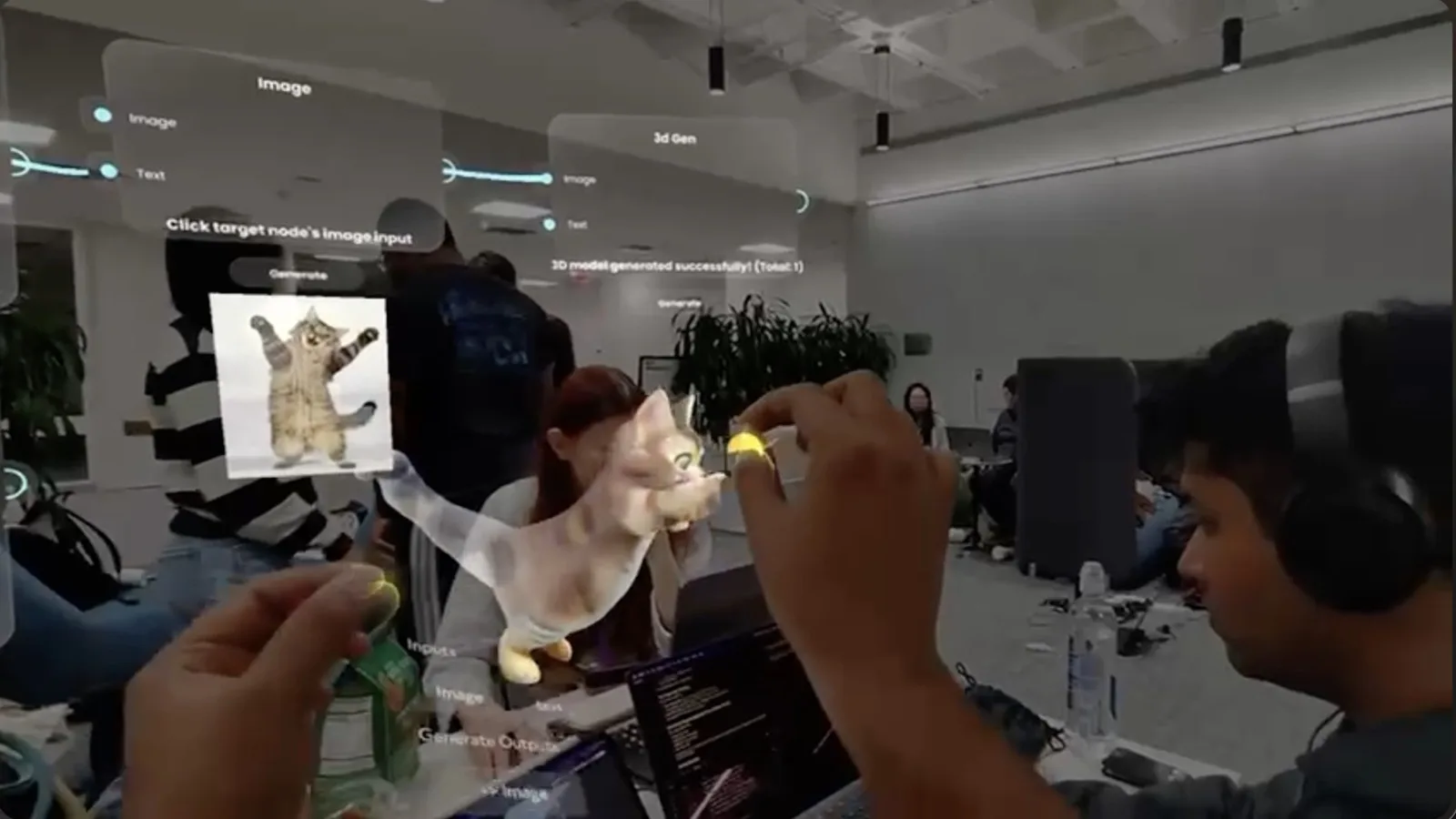
- A spatial game experience where a virtual frozen lake appears in whatever physical room you are standing in, anchored to the floor and visible only through a pair of smart glasses
These range from a Snapchat filter to a custom-built spatial experience on smart glasses hardware. All of them are AR. The unifying element is that the real world is still present and the digital content is placed within it.
Why AR is not VR
It is worth spending a moment on this because the confusion is widespread and consequential for anyone evaluating these technologies for a campaign or product.
Virtual reality requires a headset that covers both eyes completely. When you put it on, the real world disappears. You are inside a simulated environment. The experience can be visually compelling and immersive in a way nothing else matches, but you are isolated: you cannot see the people around you, you cannot interact with the physical world, and you cannot move freely without risk of colliding with something you cannot see.
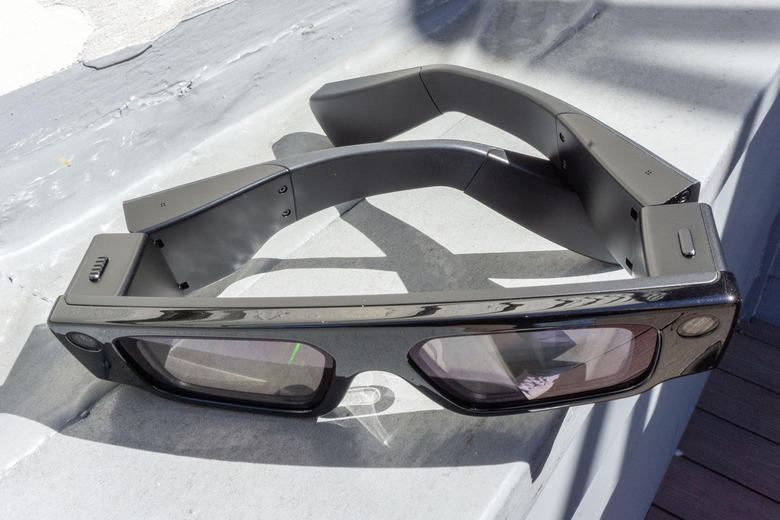
Augmented reality keeps your eyes in the real world. On a phone, your screen shows the camera feed plus the digital layer; you see both simultaneously. On smart glasses, the waveguide lens adds the digital content to your actual field of vision while the world remains visible through the transparent lens. On either device, you can look up, turn around, talk to the person next to you, and move through space normally.
For brands, this distinction matters practically. A VR experience at an event means the audience member is isolated, helmeted, and temporarily disconnected from the event itself. An AR experience means they are present in the space, still social, still in the moment, with something added.
What AR enables that other formats cannot
Every medium has things it does better than anything else. For AR, there are three things no other medium does as well:
Presence without isolation. AR delivers immersive experiences while keeping people present in their physical context. A wearable AR activation at an event means the audience is still at the event. A social AR filter means engagement happens wherever the user is.
Digital in physical space. AR can place a digital object (a product, a character, a world) into the specific physical location where the audience already is. The IKEA sofa is in your living room, at the right scale. The spatial reveal is in the event venue, visible from every angle. This is impossible for video, print, or any screen-based medium.
Interaction without a screen. Particularly on smart glasses, AR enables interaction through gesture and head movement rather than touch input on glass. Both hands stay free. The physical world stays visible. This is the first medium that genuinely delivers a hands-free interactive experience.
Is AR ready for your brand in 2026?
For some uses, AR has been ready for years. Social AR on Snapchat and TikTok reaches hundreds of millions of users and has been a proven campaign channel since 2020. If your goal is reach and engagement on platforms where your audience already spends time, that route is open and well-understood.
WebAR for product visualisation and package activation is also established. No app required, works on any modern smartphone, and the technology is reliable enough to use in campaigns without extensive fallback planning.
Wearable AR on smart glasses is at a different point. The hardware is a developer platform, not yet a consumer product at scale. The right use cases are live events, press activations, and experiences where the audience is curated and in the room. It is not a mass-reach channel. It is a premium, spatial, individual experience. For the right brief, nothing else comes close.
The common mistake is evaluating AR as a single technology and asking whether it is "ready." The question is which AR surface fits your audience, your goal, and your brief. The answer is yes for at least one of them.
For a deeper look at the wearable AR landscape and what a smart glasses activation looks like in practice, start with the wearable AR services page.
Frequently asked questions
Ready to bring AR into your next campaign?
Whether social AR, WebAR, wearable, or spatial installation, the studio helps brands find the right format and build it properly.